Compare prices on over 20,000 products

Shop from trusted merchants delivering nationwide

How Cannabis Discounts Really Work

Online cannabis prices rarely change because the product itself becomes cheaper. In most cases, prices move because discount mechanics change. Promotions, bundles, loyalty incentives, and time limited offers quietly reshape what consumers actually pay week to week.

This guide explains how cannabis discounts really work, how they affect effective price, and why headline prices can be misleading without discount context. It is designed to help consumers, journalists, and researchers interpret pricing data accurately using real retail signals rather than advertised list prices.

Understanding discounts is essential to reading any cannabis price index correctly. In many weeks, discount depth and frequency explain more price movement than base price changes.

This guide explains how cannabis discounts actually work in online retail environments. You will learn how different promotion types affect the final price you pay, how to calculate real savings across percentage-off and BOGO offers, and how bundle pricing changes the effective unit cost.

What Cannabis Discounts Are

Breaks down the real value behind percentage‑off deals, BOGO offers, bundle pricing, and loyalty rewards so shoppers understand what they’re truly saving.

How Cannabis Discounts Work Step by Step

Explains the sequence from base pricing to checkout and how promotions are applied and removed over time.

Common Discount Pitfalls

Outlines frequent errors made when interpreting prices without accounting for promotions or eligibility rules.

Discount Types You’ll See Online

Breaks down the main promotional formats used by online cannabis retailers and their typical pricing impact.

FAQs About Cannabis Discounts

Answers common questions about discount behavior, price volatility, and how to interpret pricing data accurately.

What Are Cannabis Discounts?

Cannabis discounts refer to pricing incentives offered by online retailers to lower the effective price of a product. These include percentage off promotions, buy one get one offers, bundle pricing, flash sales, and loyalty rewards.

product. These promotions are designed to stimulate demand, clear inventory, attract new customers, or reward repeat buyers. Common formats include percentage-off deals, buy one get one offers, bundle pricing, coupon codes, first-time buyer discounts, flash sales, and loyalty reward programs.

Understanding what cannabis discounts are is essential because the advertised percentage does not always reflect the true value of the offer. A 40 percent discount may apply only to selected products, may require a minimum purchase, or may be calculated from an inflated original price. Similarly, buy one get one promotions can reduce the effective unit cost significantly, but only if the shopper would have purchased multiple units anyway.

Bundle pricing lowers the per-item price when products are purchased together, while loyalty rewards accumulate value over time through points or credits. Some retailers also use threshold incentives such as free shipping over a certain spend, which changes the effective total cost of the order.

By breaking down how each type of cannabis discount works, shoppers can calculate real savings rather than relying on headline numbers. This allows for accurate price comparisons across retailers and helps consumers identify genuine value in a competitive and promotion-driven online cannabis market.
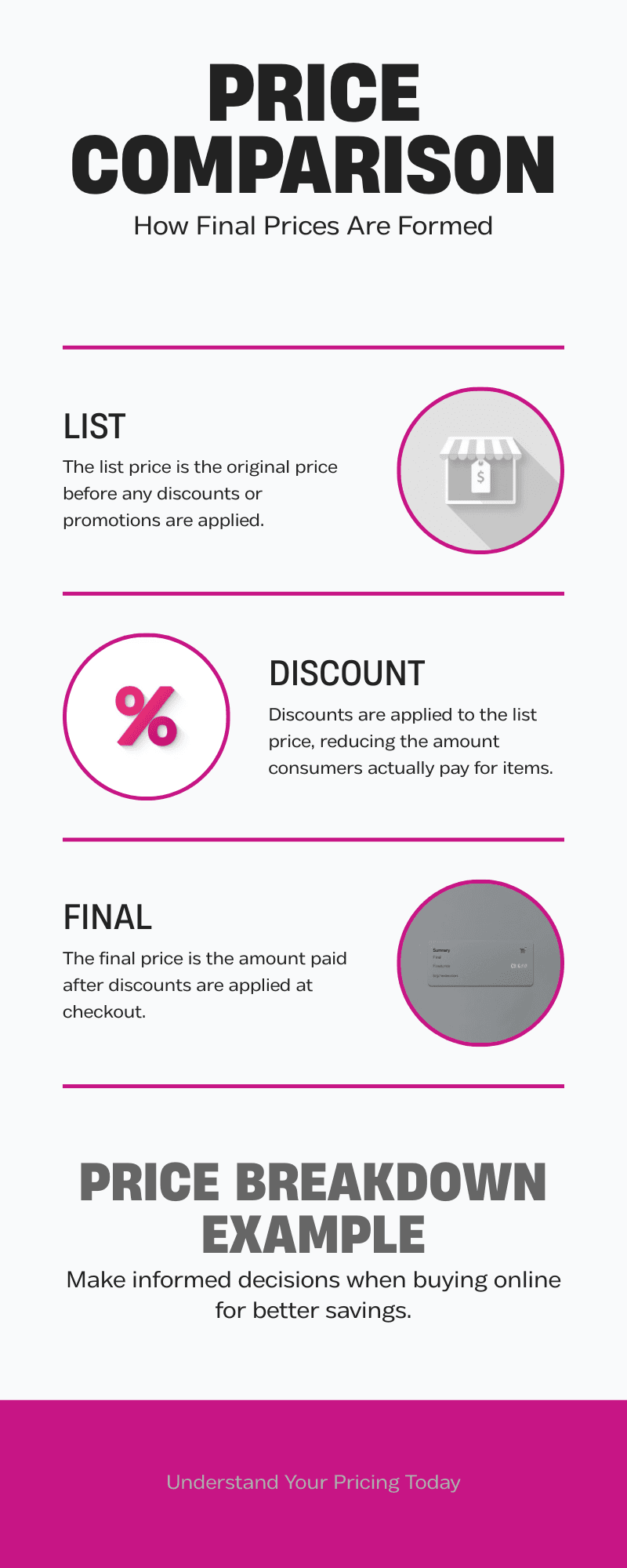
Illustration showing how a listed price is reduced by a discount to form the final price paid at checkout which is essentially cannabis discounts
Example showing the difference between list price and effective price when a discount is applied at checkout.

Cannabis discounts are temporary or conditional price reductions applied at checkout rather than
permanent changes to the product’s listed price.

They affect the effective price paid by the consumer, not the base price displayed on the product page.

A product priced at $40 with a 25% discount is not the same market signal as a product permanently repriced to $30.
Discounts are behavioral tools, not structural price changes.

How Cannabis Discounts Work Step by Step

  1. Merchants set a base list price that often remains stable for weeks.
  2. Promotions are layered through sitewide or category specific offers.
  3. Eligibility rules determine which users receive the discount.
  4. The checkout price reflects stacking rules, caps, and exclusions.
  5. Discounts expire or rotate, creating temporary price volatility.

Price indices that rely only on list prices miss the largest driver of real consumer cost.

Independent research demonstrates that discount framing can shift consumer perception more than actual price changes, which is essential context when interpreting cannabis pricing signals.

Harvard Business Review – How Discounts Change Perceived Value https://hbr.org/2017/01/the-psychology-behind-why-discounts-work

Common Cannabis Discount Mistakes

  • Assuming list price equals market price
  • Comparing prices without discount context
  • Treating discount heavy weeks as permanent price drops
  • Ignoring category specific discount behavior

Discount heavy periods often reverse without warning because the base price never changed.

Discount Types You’ll See Online

Online cannabis retailers use a range of promotional formats to influence purchasing behavior and adjust effective pricing. While the structure of these discounts may appear similar across sites, the underlying pricing impact can vary significantly depending on how the offer is applied.

Most discounts fall into predictable categories such as percentage reductions, fixed dollar incentives, bundle pricing, loyalty rewards, and first time offers. Each format changes the effective price in a different way, either by lowering the checkout total directly, encouraging larger basket sizes, or shifting value perception across multiple products.

Understanding these discount types allows shoppers to evaluate real savings rather than relying on headline percentages. By recognizing how each promotion works, consumers can compare offers across retailers using consistent pricing logic instead of marketing language.

List Price vs Effective Price

Online cannabis pricing is often misunderstood because the listed price is not what most consumers pay.

Discounts applied at checkout change the effective price without changing the base price.

For example, a product listed at $40 with a 25% discount results in an effective price of $30.
If the discount expires, the price returns to $40 even though no repricing occurred.

This distinction explains why price movements driven by promotions should not be interpreted as long term market shifts.

Cannabis Price Index Methodology

Reference documentation explaining how the CannabisDealsUS Cannabis Price Index is constructed, including data sources, discount handling, and effective price calculations based on weekly online retail data across tens of thousands of products.

CannabisDealsUS Price Index Methodology information.

Discount TypeMechanismTrue Pricing Impact
Percentage OffSitewide or category reduction applied at checkout.Lowers the checkout price. The reference price may not reflect the real baseline.
Fixed Dollar OffFlat savings unlocked after a minimum spend.Pushes larger baskets and makes per item savings harder to compare.
Bundle PricingMultiple items sold together for one combined price.Can reduce average cost per item while hiding what each item is worth alone.
Loyalty DiscountsPoints or credits applied to future purchases.Reduces long term effective cost for repeat buyers, not just one order.
First Time OffersIntro discount available only on the first purchase.Creates a low entry price that usually does not repeat in later orders.

Cannabis Discounts FAQs

Not necessarily. In most cases, cannabis discounts reduce the effective price temporarily without changing the underlying list price.
When a promotion ends, prices often return to the same level as before. This means short-term price drops caused by discounts should
not be interpreted as long-term price deflation in the market.

Apparent price volatility is usually driven by changes in discount frequency and depth rather than changes in base prices.
Merchants often rotate promotions weekly, which causes effective prices to move even when list prices remain unchanged.
This creates the impression of instability even though structural pricing is relatively stable.

How Cannabis Discounts Really Work


List price is the advertised price shown on a product page before any promotions are applied.
Effective price is the final amount a consumer pays at checkout after discounts, bundles, or loyalty incentives.
Effective price is the correct measure for understanding real consumer cost.

Some promotions use high list prices combined with deep discounts to create the perception of value.
In these cases, the discounted price may be similar to the normal effective price seen elsewhere.
Without historical context, these deals can appear more attractive than they actually are.

No. Discount behavior varies significantly by category.
Products such as vapes and edibles often receive more frequent and deeper discounts,
while flower pricing tends to rely less on aggressive promotions.
Comparing discounts across categories without context can lead to incorrect conclusions.

Yes, but selectively. These discounts lower the effective price for specific users rather than the entire market.
As a result, they can distort perceived prices if not properly accounted for.
Market-level analysis should distinguish between universal promotions and user-specific incentives.

Discounts give merchants flexibility.
They allow temporary price reductions without committing to long-term margin changes.
This approach also enables targeted promotions, inventory management, and demand stimulation
without resetting consumer expectations around base pricing.

Some merchants allow stacking of discounts, such as combining a sitewide promotion with a loyalty reward.
When stacking is allowed, effective prices can fall well below the list price.
Price analysis that does not account for stacking will overestimate what consumers actually pay.

Not always. Heavy discounting can indicate competitive pressure, but it can also reflect inventory clearing,
seasonal campaigns, or short-term acquisition strategies.
Without additional context, discount intensity alone does not signal market strength or weakness.

Sales events often create temporary distortions in effective pricing.
These periods should be analyzed separately from baseline weeks to avoid overstating long-term trends.
Responsible interpretation distinguishes between promotional anomalies and sustained pricing shifts.

How Cannabis Pricing Works Online

Explains how online cannabis prices are formed, including base pricing, discount mechanics, and why effective prices change without permanent repricing.

This page is part of the Cannabis Pricing Insights collection.

Last updated: 16/02/2026 |
| Educational content by CannabisDealsUS

Ready to Find the Best Deals?

The CannabisDealsUS Price Index tracks live discounts across 200+ verified merchants. Compare prices before you buy.

Compare Prices →All Deals →
Compare Prices, Shop Smart: Everything You Need for CBD, THC, & More

Save up to 30% by comparing prices on more than 20,000+ cannabis products

Find the Best Deals on Cannabis, Wellness, and Growing Equipment

Access exclusive deals from 200+ trusted merchants and brands

Your Trusted Source for Cannabis Products & Wellness Devices

Over 20,000+ cannabis products and wellness devices available from 200+ verified U.S. retailers

Shop Trusted Merchants for Premium Cannabis & Wellness Solutions

95% customer satisfaction rating from users shopping with verified retailers