
The single most common reason cannabis devices underperform is not device quality — it is maintenance. Residue buildup on heating elements, screens, and airways degrades performance faster than wear does.
This guide covers the cleaning routines for every major accessory category: grinders, glass pieces, vaporizers, and storage. Clear schedules, correct materials, and step-by-step processes for each.
WHAT YOU'LL LEARN
Cleaning Essentials
The supplies that handle 90% of all cannabis accessory cleaning. What to keep in stock and what each product does.
Grinder Cleaning
Resin builds up on teeth and screens within 15 uses. The freeze-brush-soak method that restores performance without damage.
Glass and Water Pipe Cleaning
How to clean bongs, pipes, and dab rigs with isopropyl alcohol and salt. Frequency, process, and how to handle complex percolators.
Vaporizer Cleaning
Heating chambers, mouthpieces, vapour paths, and screens. What to clean, how often, and what to avoid damaging.
Storage Cleaning
Airtight containers, silicone storage, and rolling trays. How to clean without introducing contaminants or damaging seals.
Cleaning Schedule by Device
Quick reference schedule for all major accessories — daily, per-session, weekly, and deep-clean intervals.
FAQs
Answers on cleaning products, stubborn residue, mould prevention, and when to replace rather than clean.
Cleaning Essentials
| Item | What It Does | Notes |
|---|---|---|
| Isopropyl alcohol (91% or higher) | Dissolves resin and cannabis residue from glass, metal, and ceramic surfaces | 91%+ is significantly more effective than 70%. The higher the percentage, the less water content and the faster it dissolves resin. |
| Coarse salt (kosher or sea salt) | Acts as a mechanical abrasive inside glass pieces when combined with isopropyl alcohol | Do not use fine table salt — it dissolves too quickly to function as an abrasive. |
| Stiff-bristle brush (toothbrush size) | Scrubs teeth, screens, and accessible interior surfaces | Dedicate a brush to cleaning only — do not use one also used for personal hygiene. |
| Pipe cleaners | Reach inside narrow tube sections, downstems, and mouthpieces | Flexible pipe cleaners reach bends that brushes cannot. |
| Cotton swabs | Precision cleaning for coils, connection points, and narrow crevices | Use dry first, then alcohol-soaked for residue removal. |
| Resealable bags or containers | Soaking small parts (grinder pieces, downstems, bowls) in isopropyl alcohol | Zip-lock bags work well for flat pieces. Small glass containers for bowls and other parts. |
| Warm water | Final rinse after isopropyl alcohol cleaning | Removes alcohol residue. Always rinse fully — residual alcohol affects taste. |
Grinder Cleaning
Frequency: Light clean every 15–20 uses. Deep clean every 40–50 uses or when the grinder becomes noticeably sticky.
- Place the assembled grinder in the freezer for 30 minutes. Cold makes resin brittle and dramatically easier to remove.
- Disassemble into all individual pieces. Tap each piece over white paper or a clean surface to collect loose kief before cleaning.
- Use a stiff brush to scrub the inside of each chamber, focusing on teeth and the kief screen. Work systematically — holes in the kief screen need to be individually clear.
- For a deep clean: place metal pieces in a resealable bag with isopropyl alcohol. Seal and shake gently for 60 seconds. Soak for 20–30 minutes for heavy residue.
- Remove, brush again if needed, rinse thoroughly with warm water.
- Dry completely before reassembling. Wet threads corrode and stick.
Do not use alcohol on acrylic or painted surfaces — it will strip the finish. For acrylic grinders, warm water and a brush is the only safe cleaning method.
Glass and Water Pipe Cleaning
Frequency: Change water after every session. Light clean every 3–5 sessions. Deep clean every 10–15 sessions.
For bongs and water pipes:
- Empty all water. Remove downstem and bowl.
- Place downstem and bowl in a resealable bag with isopropyl alcohol. Seal and soak for 30–60 minutes.
- Add 3–4 tablespoons of coarse salt and enough isopropyl alcohol to coat the inside of the bong (roughly 60–100ml for a medium bong).
- Cover all openings with your hands or plugs. Shake firmly for 2–3 minutes, ensuring the salt-alcohol mixture reaches all interior surfaces.
- Empty, then rinse with warm water at least three times until all alcohol smell is gone.
- Rinse the soaked downstem and bowl, brush if needed, rinse again.
- Air dry completely before using.
For percolators: The same method applies, but complex percolators (tree, honeycomb) need more aggressive shaking and sometimes a pipe cleaner to reach individual arms. Honeycomb discs can be soaked directly in an alcohol bath for stubborn resin.
Vaporizer Cleaning
Frequency: Light clean every 5–10 sessions. Deep clean every 20–30 sessions or when vapour quality noticeably degrades.
| Component | Cleaning Method | Frequency |
|---|---|---|
| Herb chamber (ceramic or stainless) | Brush out loose herb after each session while warm. Light alcohol wipe every 5–10 sessions. | After each session (brush) + every 5–10 sessions (wipe) |
| Mouthpiece | Remove and soak in isopropyl alcohol. Rinse with warm water. Dry fully before reattaching. | Every 10 sessions or when taste degrades |
| Vapour path / tube | Pass alcohol-soaked pipe cleaners through. Allow to dry fully before use. | Every 15–20 sessions |
| Screens / filters | Soak in isopropyl alcohol, rinse, allow to fully dry. Replace rather than clean if screens are bent or torn. | Every 10–15 sessions or when airflow decreases noticeably |
| Battery contacts and exterior | Dry cotton swab only. Never use liquid on battery contacts or power components. | Weekly or when contacts appear dirty |
Critical: Never submerge any vaporizer electronics in liquid. Never use cleaning products in the battery section. Allow all cleaned components to dry completely before reassembling and powering on.
Storage Cleaning
Storage containers maintain freshness and odour control. A dirty storage container contaminates its contents and defeats the purpose of airtight storage.
- Glass jars: Wash with warm soapy water, rinse thoroughly, allow to fully air dry. Soap residue affects aroma. Deep clean with isopropyl alcohol quarterly.
- Silicone containers: Warm water and mild soap. Do not use isopropyl alcohol on silicone — it can degrade the material over time and leave residue.
- Rolling trays: Wipe with a damp cloth after each session. Deep clean with isopropyl alcohol weekly if used heavily. Trays accumulate more resin than most users expect.
- Odour-proof bags and pouches: Wipe interior with a damp cloth. Do not submerge — most odour-proof bags use activated carbon layers that are damaged by soaking.
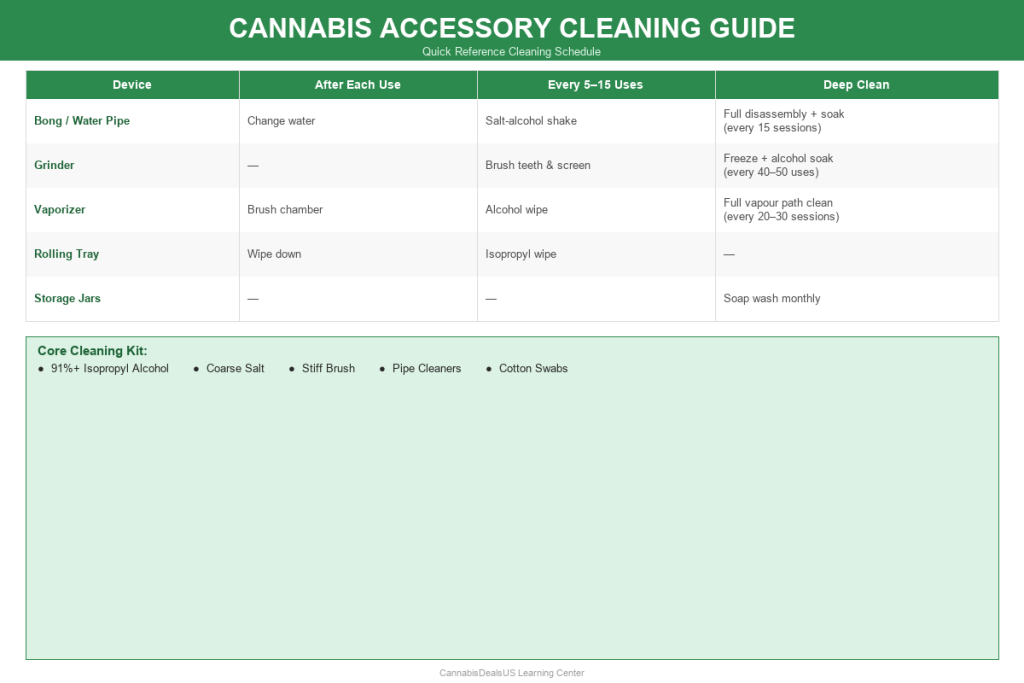
Quick Reference Cleaning Schedule
| Device | After Each Use | Every 5–15 Uses | Deep Clean |
|---|---|---|---|
| Bong / water pipe | Change water | Salt-alcohol shake clean | Full disassembly + soak every 15 sessions |
| Grinder | — | Brush teeth and screen | Freeze + alcohol soak every 40–50 uses |
| Vaporizer chamber | Brush out loose herb | Alcohol wipe | Full disassembly clean every 20–30 sessions |
| Rolling tray | Wipe down | Isopropyl wipe | — |
| Storage jars | — | — | Soap wash monthly; alcohol quarterly |
Cannabis Accessory Cleaning FAQs
Rubbing alcohol is typically 70% isopropyl. It works but is less effective than 91%+ isopropyl alcohol. The higher water content in 70% means it dissolves resin more slowly and leaves more residue. 91%+ is significantly better for cannabis accessory cleaning and is widely available.
Extended soaking in 91%+ isopropyl alcohol (1–2 hours or overnight for very heavy buildup) combined with coarse salt agitation handles most stubborn resin. For bong necks: a long pipe cleaner soaked in alcohol used as a scrubber. For vaporizer chambers: gentle scraping with a wooden or silicone tool, not metal which scratches ceramic.
Change the water after every session. Let the bong dry completely between uses if possible. Clean every 5 sessions. Mould in bongs grows in stagnant water — the solution is not letting water sit. If mould does appear, a full alcohol soak followed by hot water rinse is required, and the piece should be inspected carefully before reuse.
Replace when: cracks or chips appear in glass near the water or heat area; screens are torn and cannot be removed intact; heating elements in vaporizers produce burnt taste even after deep cleaning; grinder teeth are visibly worn or bent and the grind quality has permanently deteriorated. Good-quality borosilicate glass and anodised aluminium grinders can last years with proper cleaning.
Soap and warm water works for exterior cleaning and storage containers but does not dissolve cannabis resin effectively. Use isopropyl alcohol for surfaces that contact cannabis. Soap is fine as a final rinse agent to remove residual alcohol smell after an isopropyl cleaning.
Browse Cleaning Supplies
Find cleaning kits, isopropyl alcohol sets, and pipe cleaners from headshop merchants.
Last updated: 02/24/2026 | Author: CannabisDeals Editorial Team | Educational content by CannabisDealsUS
Ready to Find the Best Deals?
The CannabisDealsUS Price Index tracks live discounts across 200+ verified merchants and brands. Compare prices before you buy.
Compare Prices →All Deals →