
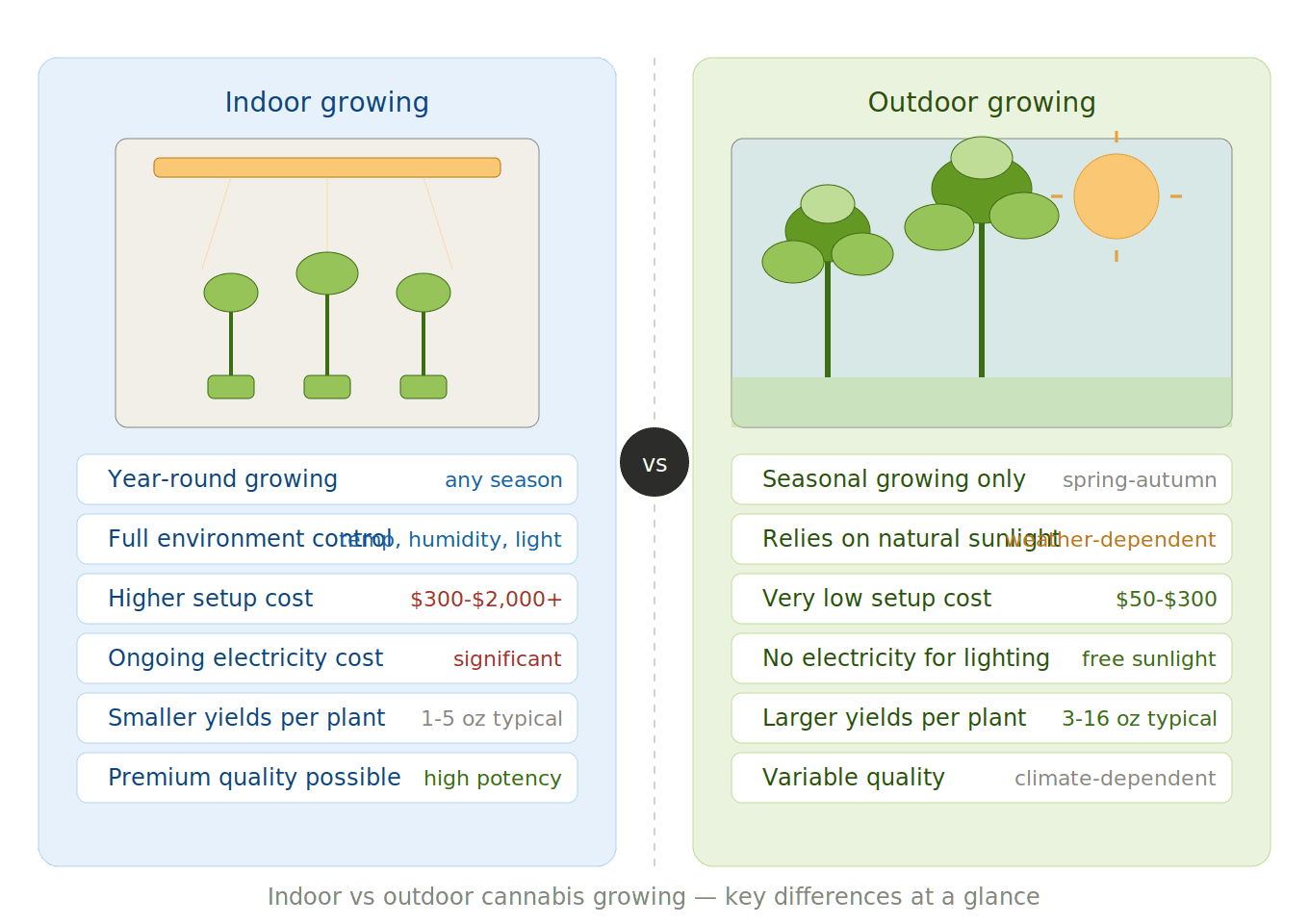
Indoor and outdoor growing are fundamentally different undertakings. The choice determines your equipment list, cost structure, timeline, level of control, and what kind of results are realistic.
This guide compares both methods across every dimension that matters for a buyer choosing their first grow setup — with the equipment implications of each choice clearly explained.
CannabisDealsUS Price Index — Grow Equipment
The CannabisDealsUS Price Index tracks 1,400 grow equipment SKUs with an average effective price of £49.76. The category index has held at baseline (100.10) for five consecutive weeks — the most price-stable hardware category tracked.
For indoor vs outdoor cost comparisons, the equipment budget estimates in this guide reflect current tracked market prices. The grow equipment market is not experiencing significant price movement, making current pricing a reliable planning baseline.
Source: CannabisDealsUS Price Index — updated weekly. Data as of week ending 16 Feb 2026.
WHAT YOU'LL LEARN
Side-by-Side Comparison
The core differences between indoor and outdoor growing across cost, control, yield, timeline, and equipment requirements — in one table.
Indoor Growing
What indoor growing provides, what it costs, and what equipment it requires. Lighting, ventilation, and space management explained.
Outdoor Growing
What outdoor growing provides, what the limitations are, and what equipment is still required even when growing in natural conditions.
Equipment Differences
A direct comparison of the equipment list for indoor vs outdoor — what each method requires, what each eliminates, and where the costs land.
Climate and Environment
How outdoor growing depends on climate, season, and local conditions — and what this means for equipment choices and legal considerations.
Which Method Is Right for You
A five-question framework for choosing between indoor and outdoor based on your space, budget, climate, and goals.
FAQs
Answers on yield, cost, equipment, and the practical implications of each growing method.
Side-by-Side Comparison
| Factor | Indoor | Outdoor |
|---|---|---|
| Cost to start | £250–£500+ for a basic tent setup with lighting and ventilation | £50–£150 for containers, soil, and nutrients — no lighting cost |
| Ongoing electricity cost | £80–£150 per grow cycle in electricity | Minimal — sunlight is free |
| Control over environment | Full control — temperature, humidity, light cycle, CO₂ | Limited — dependent on local climate, weather, and season |
| Year-round growing | Yes — light cycles controlled artificially | No — limited to growing season (typically May–October in the Northern Hemisphere) |
| Typical yield | Higher yield per plant with experience and proper setup | Often higher yield per plant outdoors in a good season, but fewer grows per year |
| Privacy and discretion | High — contained within a grow tent or room | Lower — outdoor plants are visible and produce significant odour at harvest |
| Pest and disease risk | Lower — controlled environment limits exposure | Higher — exposure to insects, mould, and weather damage |
| Equipment required | Grow tent, LED, extraction fan, carbon filter, fans, pH meter, nutrients | Containers or raised beds, soil, pH meter, nutrients, pest management |
| Skill level required | Moderate — multiple variables to manage simultaneously | Lower barrier to entry — nature handles lighting and basic environment |
Indoor Growing
Indoor growing gives the grower complete control over every variable that affects cannabis development: light spectrum, light cycle duration, temperature, humidity, CO₂ levels, and airflow. That control comes at a cost — electricity, equipment, and active management.
What indoor growing delivers:
- Year-round grows on any cycle you choose. You control when plants flower by switching the light cycle to 12/12.
- Multiple grows per year — typically 3–4 complete cycles annually with photoperiod strains, more with autoflowers.
- Predictable results. Once a setup is dialled in, each grow follows the same trajectory without weather dependency.
- High potency and terpene preservation. Controlled environment allows the plant to develop without the stress of temperature swings and weather events.
What indoor growing requires:
See the Cannabis Growing Equipment guide for a full indoor equipment list. Core requirements: grow tent, LED lighting matched to tent size, inline extraction fan with carbon filter, internal oscillating fan, pH meter, and nutrients.
Outdoor Growing
Outdoor growing uses natural sunlight — the most powerful and full-spectrum light source available. A healthy outdoor plant in a suitable climate can produce significantly more per plant than an indoor plant, simply because the sun delivers more light hours and intensity than any artificial system.
What outdoor growing delivers:
- Lower equipment cost — no lighting system required, which eliminates the single largest indoor expense.
- Very large yields per plant with long growing seasons. Outdoor plants can grow to 2–3 metres in height given space and a long season.
- Natural terpene expression from the full light spectrum and environmental stressors (mild stress often improves terpene profiles).
What outdoor growing requires:
- A climate with a growing season long enough to complete the flowering cycle — typically 10–16 weeks depending on the strain.
- A private, secure outdoor space (legal and security considerations apply).
- Active pest and disease management — spider mites, aphids, powdery mildew, and botrytis are all common outdoor threats.
- pH management remains essential — soil pH outdoors is just as important as indoors and is often overlooked by beginners assuming natural soil is adequate.
Equipment Differences
| Equipment Category | Indoor | Outdoor |
|---|---|---|
| Grow space | Grow tent: £50–£150 | No tent required. Containers or raised beds: £20–£50 |
| Lighting | LED grow light: £80–£200+ | None — natural sunlight |
| Ventilation | Inline fan + carbon filter + oscillating fan: £80–£130 | None required indoors. Outdoor plants use natural airflow. |
| Growing medium | Cannabis-specific soil or coco coir: £20–£40 | Quality outdoor soil or container mix: £20–£50 |
| Containers | Fabric pots 11–25 litre: £15–£30 | Fabric pots or raised beds: £20–£60 (larger containers for bigger plants) |
| pH management | Digital pH meter + pH up/down: £25–£50 | Same requirement — often overlooked but equally important outdoors |
| Nutrients | Full cycle veg and bloom nutrients: £25–£60 | Same requirement — outdoor soil often needs supplementing |
| Pest management | Minimal — occasional preventative measure | Required — neem oil, insecticidal soap, or organic pest control: £15–£30 |
| Total estimated cost | £300–£600 for a basic functional setup | £100–£200 for a container outdoor setup |
Climate and Environment Considerations
Outdoor cannabis growing is viable in climates with a minimum 5-month frost-free growing season. In the US, most states south of the 49th parallel can support outdoor grows. The Pacific Northwest, California, and the Southwest offer optimal conditions.
| Climate Factor | Why It Matters | How to Manage |
|---|---|---|
| Growing season length | Photoperiod strains need 10–16 weeks of flowering after summer solstice. Short seasons may not complete the cycle before first frost. | Choose autoflowering strains for short seasons — they complete in 8–10 weeks regardless of light cycle. |
| Rainfall and humidity | High humidity during late flowering promotes botrytis (bud rot), which can destroy a harvest in days. | Choose mould-resistant strains, improve airflow around plants, and harvest early if weather turns wet. |
| Temperature extremes | Cannabis grows best between 20°C–30°C. Temperatures above 35°C or below 10°C cause stress and slow development. | Select site carefully for sun exposure and wind protection. Containers allow plants to be moved if conditions deteriorate. |
| Pest pressure | Varies significantly by region. Spider mites, aphids, caterpillars, and thrips are the most common cannabis pests. | Regular inspection, preventative neem oil applications, and companion planting (basil, marigolds) reduce pest pressure. |
Which Method Is Right for You
Answer these five questions:
- Do you want to grow year-round? If yes → indoor. Outdoor is limited to one growing season per year.
- What is your equipment budget? Under £200 → outdoor is more accessible. £300+ → indoor becomes practical. Under £100 → outdoor only.
- Do you have private outdoor space? If no → indoor. Outdoor requires a location that is legally compliant and sufficiently private.
- Is your climate suitable? Check your frost-free season length. If less than 5 months → autoflowers only outdoors, or move to indoor.
- How much ongoing management do you want? Indoor requires active, consistent management of multiple variables. Outdoor is more forgiving of occasional neglect but requires pest vigilance.
Most beginners who have access to private outdoor space and are in a suitable climate start outdoors — it is cheaper and more forgiving. Most beginners without outdoor space or in unsuitable climates start with a small indoor tent setup.
Indoor vs Outdoor Growing FAQs
The UK climate supports outdoor cannabis growing from late May to late September/early October. Autoflowering strains are well-suited to the UK growing season. However, growing cannabis without a licence is illegal in the UK regardless of method. This information is provided for educational purposes only.
Indoor growing typically produces higher consistency and can achieve higher potency and terpene expression through environmental control. However, outdoor cannabis grown in an ideal climate with quality genetics can match or exceed indoor quality — and often has more complex terpene profiles from the natural full-spectrum light and environmental stressors.
Container-grown outdoor plants can be moved indoors temporarily to escape severe weather. However, moving a large outdoor plant into an indoor space without appropriate lighting will cause it to become light-stressed quickly. This is a short-term emergency measure, not a sustainable approach.
For the equipment itself, yes — significantly cheaper. Over multiple grow cycles, indoor costs continue (electricity, nutrients, replacement parts) while outdoor costs are primarily one-time setup costs for containers and soil. Long-term, outdoor growing in a suitable climate is considerably cheaper per gram produced.
With photoperiod strains: typically 3–4 complete cycles per year depending on vegetative period length. With autoflowering strains: potentially 4–6 cycles per year since they complete faster and the light cycle does not need changing. Most home indoor growers run 3 cycles annually as a practical target.
Browse Grow Equipment
Compare grow tents, LED lights, and nutrients from trusted merchants.
Last updated: 02/24/2026 | Author: CannabisDeals Editorial Team | Educational content by CannabisDealsUS
Browse Products
Ready to Find the Best Deals?
The CannabisDealsUS Price Index tracks live discounts across 200+ verified merchants and brands. Compare prices before you buy.
Compare Prices →All Deals →