
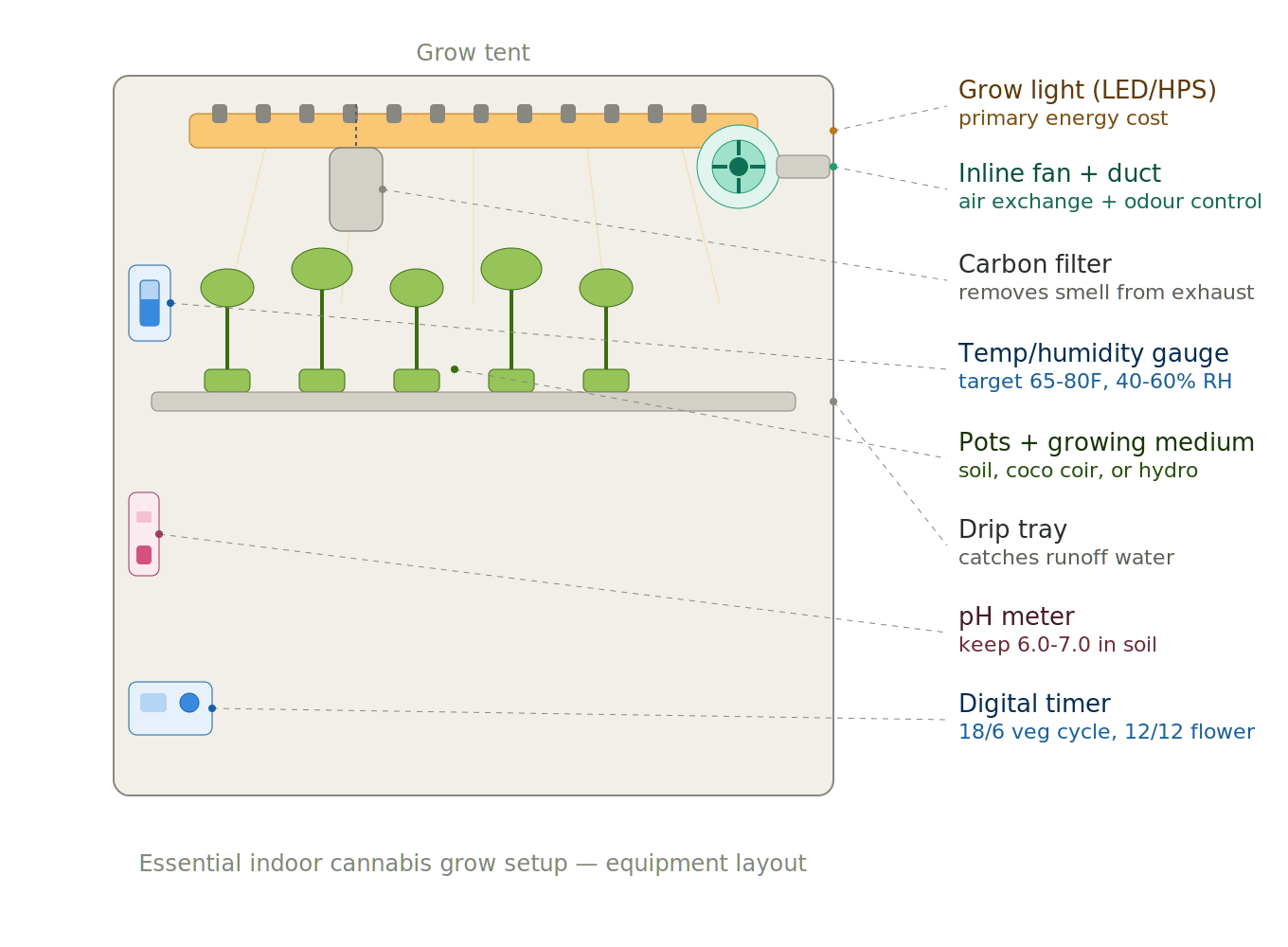
Starting an indoor cannabis grow does not require a large investment or specialist knowledge, but it does require choosing the right equipment in the right order. Most beginners spend money on the wrong things first and then spend again to fix the setup.
This guide covers what you actually need for a first grow, in the order you need it, with clear explanations of what each piece of equipment does and what to prioritise on a budget.
This page is part of the CannabisDealsUS Learning Center. For equipment pricing and merchant comparisons, use the Grow Hub below.
CannabisDealsUS Price Index — Grow Equipment
The CannabisDealsUS Price Index tracks 1,400 grow equipment SKUs across 200+ merchants. The Grow category index has held at 100.10 for five consecutive weeks — the most stable category on the platform — with an average effective price of £49.76.
Five weeks of baseline-level pricing means grow equipment is neither inflating nor discounting. This is a buyer-neutral market: prices are predictable, and there is no urgency to buy before a price rise or advantage in waiting for a sale. Budget with confidence using current prices.
Source: CannabisDealsUS Price Index — updated weekly. Data as of week ending 16 Feb 2026.
WHAT YOU'LL LEARN
The Essential Equipment List
The six categories every indoor grow needs, from grow space and lighting to growing medium and nutrients. What is non-negotiable and what can wait.
Grow Space: Tent vs Room
Grow tents vs dedicated rooms — what each provides, what a basic tent setup looks like, and what size is suitable for a first grow.
Lighting: The Most Important Decision
LED vs HID vs CFL — how each works, what the light output numbers mean, and what a beginner grower should buy at different budgets.
Ventilation and Air Circulation
Why airflow matters, what an extraction fan does, and the minimum setup required to maintain healthy grow conditions.
Growing Medium and Containers
Soil vs coco coir vs hydro — what each medium requires, which is most forgiving for beginners, and what container size to start with.
Nutrients and pH
What cannabis needs to grow, how nutrients work, and why pH management is the skill that separates successful grows from struggling ones.
Common Beginner Mistakes
The equipment and setup errors that most commonly cause first grows to fail, including overbuying, poor ventilation, and ignoring pH.
FAQs
Answers on space requirements, electricity costs, yield expectations, and what to buy first on a limited budget.
The Essential Equipment List
Six categories are non-negotiable for any indoor grow. Everything else is optional or can be added later once you understand your setup.
| Category | What You Need | Can You Skip It? |
|---|---|---|
| Grow space | A dedicated grow tent or enclosed room with reflective interior walls | No — cannabis needs an enclosed, controllable light environment |
| Lighting | A grow light matched to your space size | No — standard household lighting does not produce the spectrum or intensity cannabis needs |
| Ventilation | An inline extraction fan + carbon filter (for odour) + oscillating fan for air movement | No — stagnant air causes mould, heat stress, and weak stems |
| Growing medium | Soil, coco coir, or hydroponic medium | No — plants need something to root in |
| Containers | Pots or fabric pots sized to your plant count and grow space | No — correctly sized containers are critical for root development |
| Nutrients and pH management | Basic veg and bloom nutrients + a pH meter + pH up/down solution | No — cannabis requires specific nutrient ratios and will not tolerate pH outside 6.0–7.0 (soil) or 5.5–6.5 (coco/hydro) |
Grow Space: Tent vs Room
For beginners, a grow tent is almost always the right choice over a converted room or DIY space.
| Option | Pros | Cons | Cost |
|---|---|---|---|
| Grow tent | Reflective interior maximises light efficiency, contained environment is easier to control, portable and removable, designed specifically for growing | Fixed footprint, limited height in smaller models | £40–£150 depending on size |
| Converted room/wardrobe | More space flexibility, no tent cost | Requires lining with reflective material, harder to control environment, not removable | Variable — often costs more than a tent when properly outfitted |
| Purpose-built grow room | Maximum control and scalability | High cost, permanent installation, overkill for a first grow | £300+ |
Recommended starter tent sizes:
- 60cm × 60cm × 140cm — 1–2 plants. Suitable for a first-time grow to learn the process.
- 80cm × 80cm × 160cm — 2–4 plants. Good step-up size with more flexibility.
- 120cm × 120cm × 200cm — 4–6 plants. Full beginner setup with room to scale technique.
Lighting: The Most Important Equipment Decision
Light drives photosynthesis and determines yield potential more than any other variable. Underpowered lighting is the most common reason first grows underperform.
| Type | How It Works | Efficiency | Heat Output | Best For |
|---|---|---|---|---|
| LED (modern quantum board) | Full-spectrum LEDs designed for plant growth. Modern models are highly efficient. | Very high — less electricity per usable light | Low to moderate | Most beginners. Lower running costs, less heat management, good spectrum. Most popular in the current market. |
| HID (HPS/MH) | High-Intensity Discharge. HPS for flowering, Metal Halide for veg. The traditional professional standard. | Moderate — effective but draws more electricity | High — requires active cooling and careful tent management | Growers wanting maximum yield per watt. More demanding of ventilation. |
| CFL (compact fluorescent) | Standard fluorescent bulbs adapted for growing. Low cost, low heat. | Low — adequate for seedlings and small clones only | Very low | Seedling/clone stage only. Not sufficient for vegetative or flowering in standard grows. |
Light sizing guide:
- 60cm × 60cm tent: 100W–150W LED
- 80cm × 80cm tent: 150W–200W LED
- 120cm × 120cm tent: 300W–400W LED
LED manufacturers often quote inflated wattage figures. Look for the actual drawn wattage (what the light actually pulls from the wall), not the marketed equivalent wattage. A reputable 200W drawn LED covers an 80cm × 80cm tent adequately.
Ventilation and Air Circulation
Cannabis plants need fresh air, CO₂ replenishment, and gentle air movement. Without adequate ventilation, grows develop mould, heat stress, and weak stems that cannot support buds.
Three components:
- Inline extraction fan: Pulls stale, hot air out of the tent and pushes it through a carbon filter to remove odour. Size to your tent — a 100mm fan for tents up to 80cm², a 150mm for 120cm² tents.
- Carbon filter: Filters odour from extracted air. Required if discretion matters. Connect inline to the extraction fan.
- Oscillating clip fan: Provides internal air movement. Strengthens stems (plants grown without airflow develop weak stems) and prevents humidity hot spots. A single small oscillating fan is adequate for most beginner tents.
The extraction fan should cycle the full air volume of the tent once per minute. For a 120cm × 120cm × 200cm tent (288 litres), a fan rated at 300m³/hour is adequate.
Growing Medium and Containers
| Medium | How It Works | Beginner Friendliness | Notes |
|---|---|---|---|
| Soil (cannabis-specific mix) | Traditional growing medium with built-in nutrient buffering. Forgiving of minor pH and feeding errors. | Very high — the recommended starting point | Use a quality cannabis-specific soil mix (not standard garden compost). Provides a buffer against beginner mistakes. |
| Coco coir | Coconut fibre medium that requires full nutrient feeding from the start. More control, faster growth, but less forgiving. | Moderate — steeper learning curve than soil | Excellent second grow medium once you understand nutrient management. Reusable and more sustainable than soil. |
| Hydroponics | Soil-free growing in water with dissolved nutrients. Fastest growth, highest yields, most control. | Low — requires precise management of multiple variables simultaneously | Not recommended for a first grow. Learn soil first. |
Container sizing: 11-litre fabric pots are the standard starting size for most photoperiod strains. Fabric pots prevent overwatering by air-pruning roots and promoting healthy root structure. Plastic pots work but fabric is the preferred choice at current price points.
Nutrients and pH Management
Cannabis requires different nutrients at different growth stages. Getting this wrong is the second most common reason beginner grows fail (after inadequate lighting).
The basic nutrient schedule:
- Vegetative stage (weeks 1–4+): Higher nitrogen (N) relative to phosphorus (P) and potassium (K). Supports leaf and stem development.
- Flowering stage (weeks 5–12+): Lower nitrogen, higher phosphorus and potassium. Supports bud development. Many growers switch to a dedicated bloom nutrient at this stage.
- Flush (final 1–2 weeks): Plain water only. Removes residual nutrient salts from the medium before harvest.
pH management — the most important skill for beginners:
Cannabis can only absorb nutrients within a specific pH range. Outside this range, nutrients are present but unavailable to the plant — a condition called nutrient lockout. Most beginner grows that show yellowing, curling, or discolouration have a pH problem, not a nutrient deficiency.
- Soil target pH: 6.0–7.0 (optimal 6.2–6.8)
- Coco coir target pH: 5.5–6.5 (optimal 5.8–6.2)
A digital pH meter (£15–£30) and pH up/down solution are non-negotiable purchases. Test every watering. Adjust until the pH of water going in is within the correct range.
Common Beginner Growing Mistakes
- Underbuying on lighting. Light is the variable that most directly limits yield. A proper LED for your tent size costs £80–£200 but determines 60–70% of your result. This is not where to cut the budget.
- Skipping pH management. A £20 pH meter prevents the most common beginner problem. Nutrient lockout caused by pH imbalance causes more grow failures than any other single factor.
- Overwatering. Cannabis roots need oxygen as well as water. Watering too frequently prevents the medium from drying adequately between waterings. Water only when the top inch of soil is dry and the pot feels noticeably lighter.
- Overfeeding nutrients. More nutrients do not produce more growth. Start at half the recommended dose and increase gradually. Nutrient burn (brown leaf tips) is a common beginner problem from feeding too heavily.
- Poor ventilation. A grow tent without adequate airflow develops mould and heat stress quickly. The extraction fan and internal oscillating fan are not optional equipment.
- Buying genetics last. The quality of the seed or clone is the starting point for everything. A poor genetic in ideal conditions will always underperform a strong genetic in adequate conditions.
Cannabis Growing Equipment FAQs
A 60cm × 60cm × 140cm grow tent fits in a wardrobe-sized space and is adequate for 1–2 plants as a learning setup. An 80cm × 80cm tent is a better starting point if you have the space — it gives more room to work and scales up naturally.
Entry-level setup for a 60cm × 60cm tent: tent £50, LED £60–£80, extraction fan + carbon filter £60–£80, oscillating fan £15, pots and medium £20–£30, pH meter and nutrients £30–£50. Total: £235–£285 to start. An 80cm × 80cm setup with better lighting runs £350–£450.
A 200W LED running 18 hours per day (veg cycle) draws 3.6 kWh per day. At average UK electricity rates, that is roughly £0.90–£1.10 per day. Flowering at 12/12 light cycle reduces this. A full grow (12–16 weeks) typically costs £80–£150 in electricity for a basic setup.
A realistic first-grow indoor yield in a 60cm × 60cm tent is 15–50g dried. Technique, genetics, and light intensity determine the result more than any other factor. Experienced growers in the same space with better technique and genetics routinely achieve 80–150g.
Growing cannabis is illegal in most US states without a licence and in the UK without specific authorisation. Check the laws in your jurisdiction before purchasing any grow equipment. CannabisDealsUS provides this information for educational purposes only.
Autoflowering strains are generally recommended for beginners. They flower automatically based on age rather than light cycle, are typically smaller and faster (8–10 weeks from seed to harvest), and are more forgiving of environmental inconsistency than photoperiod strains.
Browse Grow Equipment
Compare 1,400+ grow products from trusted merchants.
Last updated: 02/24/2026 | Author: CannabisDeals Editorial Team | Educational content by CannabisDealsUS
Browse Products
Ready to Find the Best Deals?
The CannabisDealsUS Price Index tracks live discounts across 200+ verified merchants and brands. Compare prices before you buy.
Compare Prices →All Deals →