Compare prices on over 13,000 products

Shop from trusted merchants delivering nationwide

US Cannabis Price Index: Weekly Pricing Data Across 20,000+ Products

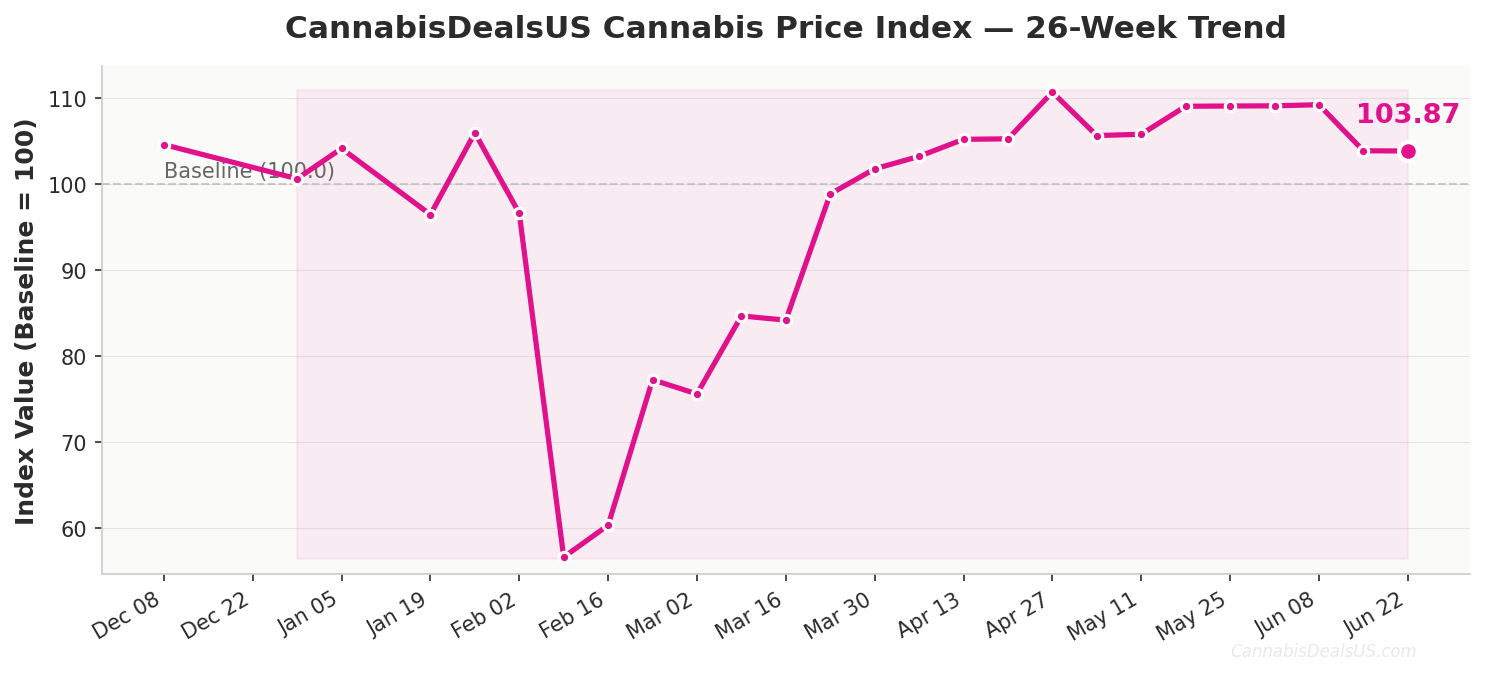
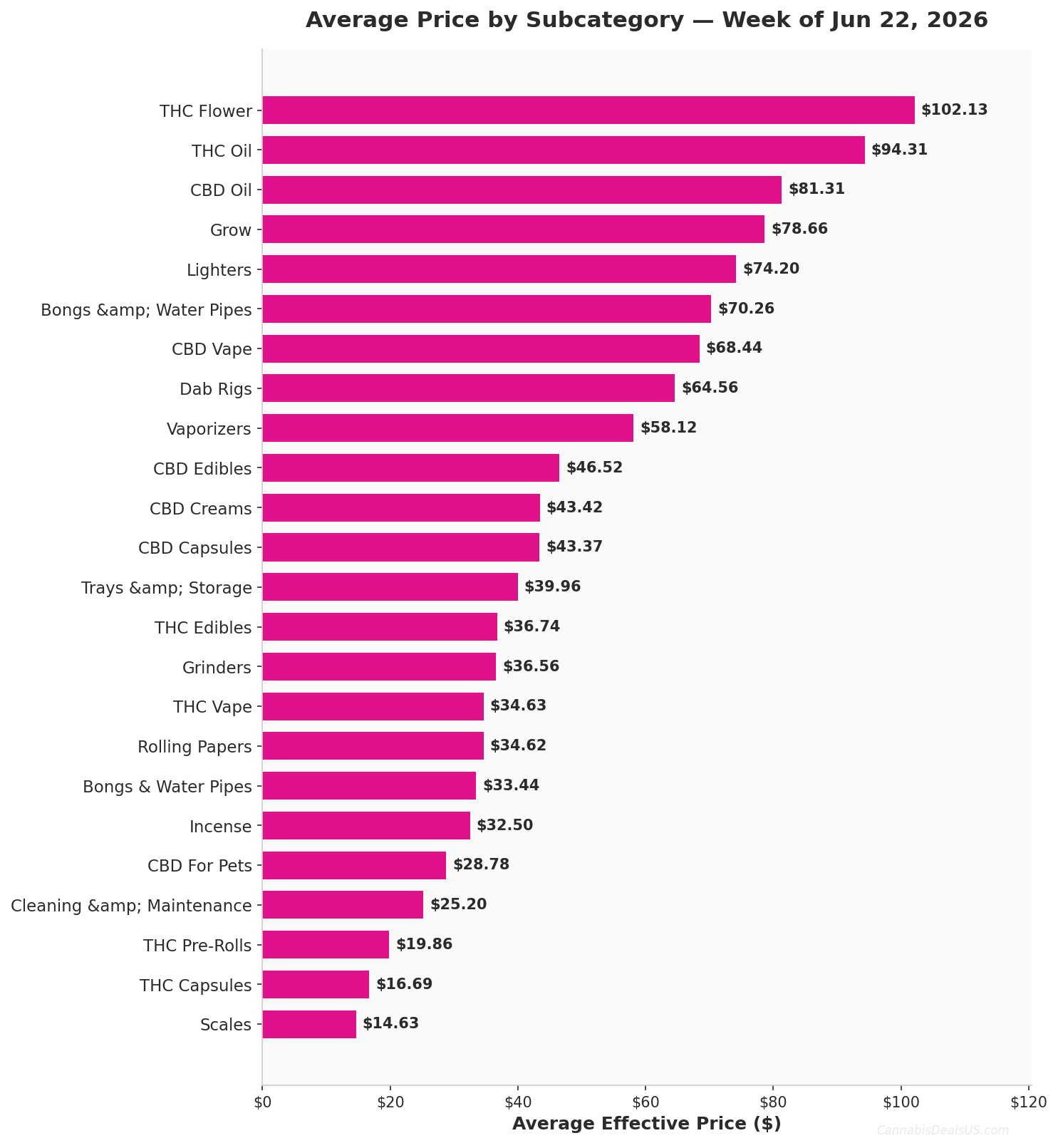
The CannabisDealsUS Price Index tracks weekly pricing movements across more than 15,000 cannabis products in the United States, covering both CBD and THC categories across multiple online retailers.

The index is designed to support journalists, analysts, and researchers seeking independent, data driven insight into cannabis pricing trends, discount behavior, and category level volatility.

This is a research resource. No promotional intent.

What the Cannabis Price Index Covers

  • 20,000+ actively listed cannabis products
  • CBD and THC categories
  • Subcategories including flower, vapes, edibles, oils, capsules, topicals, vaporizers and headshop items.
  • 50+ US retailers
  • Weekly snapshots and historical comparisons

The dataset reflects listed prices and promotional activity at the time of capture.

Latest Price Index Updates

Attribution

If referencing this data, please attribute as:

CannabisDealsUS Price Index

Founder and data source:
Theo Valmis
Founder, CannabisDealsUS
https://cannabisdealsus.com


Historical Price Trends: What the Data Shows

Historical Price Trends: What the Data Shows

Since launching systematic tracking in early 2024, several clear market patterns have emerged.

CBD Market Stabilization

CBD pricing has largely stabilized.
1000mg CBD oil products now average $35–$45 per bottle, with limited month-over-month variance.

This reflects:

  • Mature supply chains
  • Optimized production and distribution
  • Reduced speculative pricing

Premium CBD products, including full-spectrum and nano-emulsion formulations, continue to command 40–60% price premiums, indicating sustained willingness to pay for perceived quality.


THC Pricing Volatility

THC categories remain more volatile.

  • Vape cartridges and disposables show the highest weekly swings, often 12–25%
  • Flower pricing is more stable in mature markets and less predictable in newer ones
  • Edibles sit between value and premium tiers, with gradual price compression

Overall, THC markets appear 2–3 years behind CBD in terms of pricing maturity.


Discount Patterns and Promotions

A key shift observed in late 2024 and 2025:

  • Fewer promotions overall
  • Deeper discounting when promotions occur

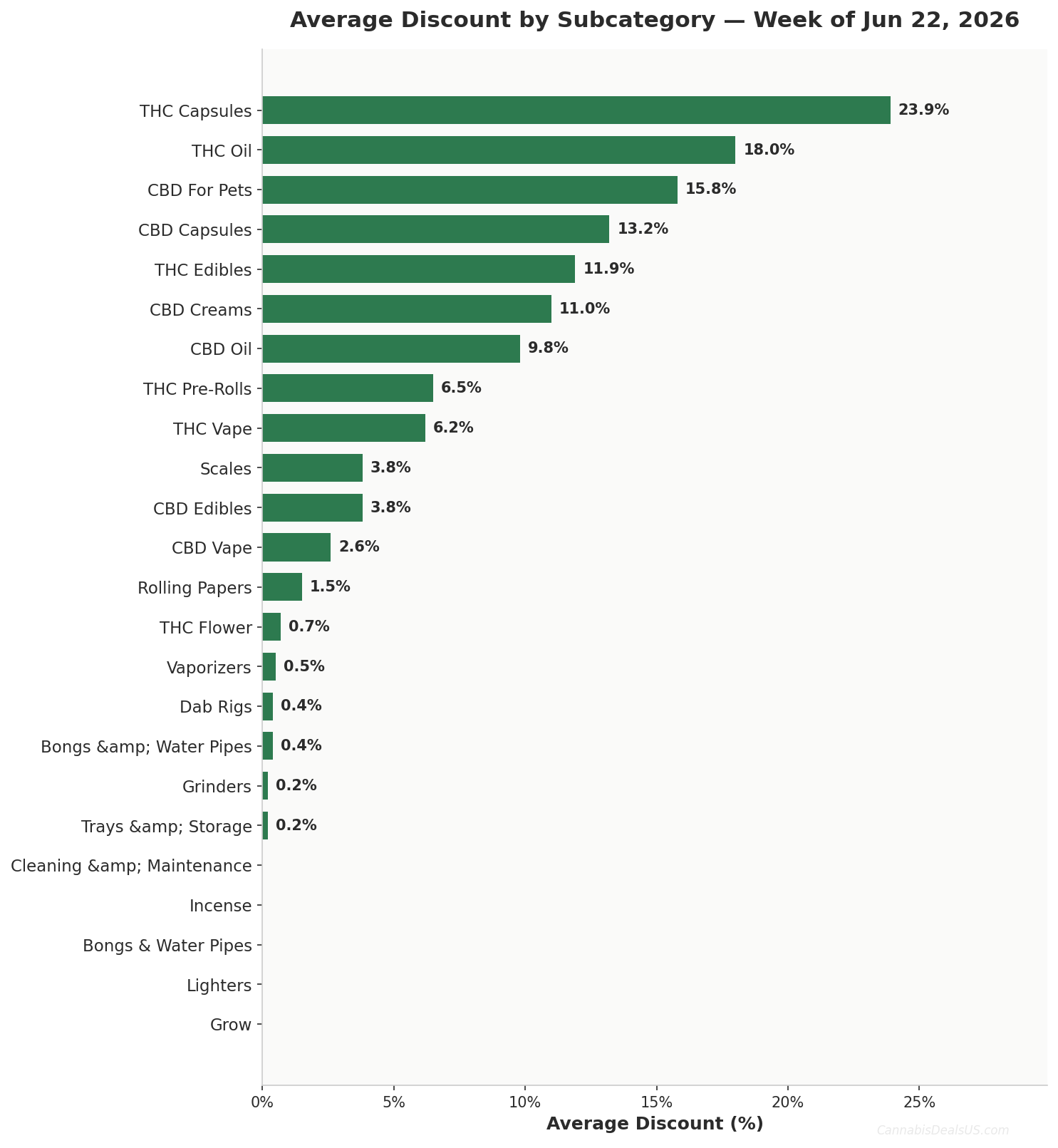
Average discount depth has increased to 25–35%, up from 15–20% earlier in the year. Flash sales and event-based promotions now dominate over constant discounting.

Seasonal events such as 4/20 and Green Wednesday generate 3–4× normal promotional activity, with discounts reaching 40–50% in select categories.


Category-Specific Insights

Vaporizers and Devices

Dry herb vaporizers have declined 20–30% year-over-year, driven by manufacturing efficiencies and competition. Premium devices remain price-stable.

Concentrates

Wax, shatter, and live resin show extreme regional variance, reflecting differences in regulation and market maturity.

Topicals

CBD and THC topicals maintain the highest estimated margins, with stable pricing despite increased competition.


What This Means for the Market

The data reflects an industry transitioning from early growth to normalization.

  • CBD pricing has commoditized
  • THC markets are following, but remain uneven
  • Retailers face margin pressure, leading to strategic promotions
  • Consolidation pressure is likely to increase

For consumers, this creates timing-based savings opportunities.
For analysts and investors, the data suggests continued compression and brand-driven differentiation.


What We Analyze

Using weekly snapshots, we monitor:

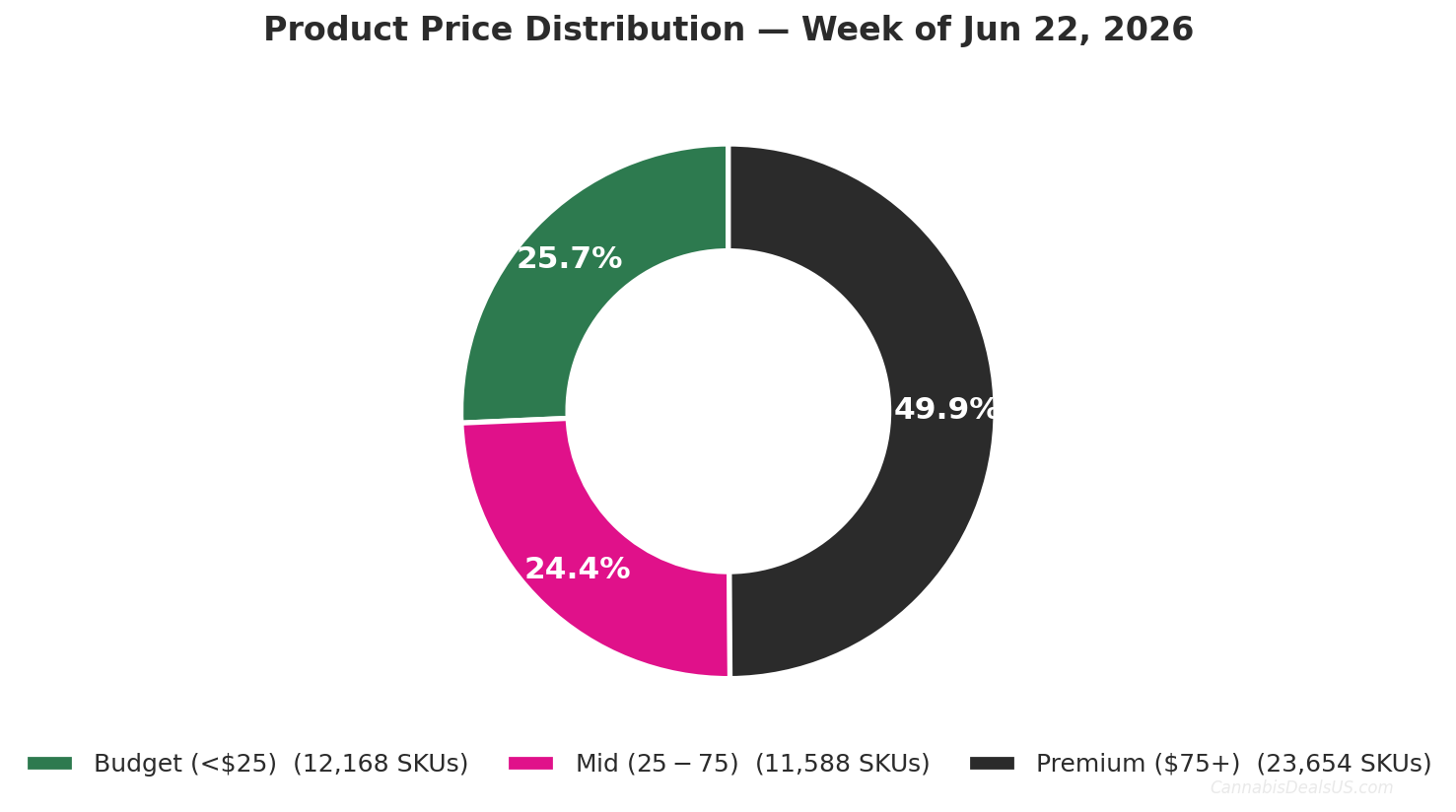
  • Price dispersion between CBD and THC
  • Discount depth versus frequency
  • Category-level volatility
  • Short-term reactions to regulatory or market signals
  • Early indicators of stabilization or oversupply

Insights are aggregated at category and subcategory level to reduce retailer-specific bias.


Recent Market Signals

Recent weekly data highlights:

  • Widening divergence between CBD and THC pricing
  • Deeper but less frequent discounts
  • Higher volatility in vapes and edibles than flower
  • Early stabilization in select CBD subcategories

Signals evolve weekly as new data is captured.


Methodology (Summary)

  • Prices captured weekly from public product pages
  • Products normalized into consistent CBD and THC categories
  • Obvious pricing errors and outliers excluded
  • Analysis focuses on directional movement, not prediction

This index reflects market behavior, not inventory or sales volume.


Data Collection and Analysis Methodology

Data Collection

  • Automated capture every Monday at 6:00 AM EST
  • 50+ nationwide online retailers
  • Product-level attributes including price, category, potency, and timestamp

Products out of stock for four consecutive weeks are removed from active tracking but retained historically.


Normalization and Quality Control

  • Price per milligram normalization where applicable
  • Standardized volume and unit conversion
  • Manual category verification
  • Statistical and sequential outlier detection

Approximately 2–3% of data points are excluded weekly.


Index Calculation

  • Overall index (base period January 2024 = 100)
  • Category-specific indices
  • Volatility score
  • Discount activity metrics

Limitations

  • Online-only pricing
  • Listed prices, not transaction prices
  • No direct sales volume data
  • Regional dispensary pricing not fully represented

Transparency about these constraints is essential for accurate interpretation.


Use Cases

The CannabisDealsUS Price Index is used to support reporting on:

  • Cannabis market pricing trends
  • Retail margin pressure
  • Consumer price sensitivity
  • Post-legalization normalization
  • Category-specific volatility

Category-level insights are available on request.


New to cannabis market analysis? Our Learning Center provides comprehensive guides on understanding cannabis pricing, product categories, and market fundamentals, helping you interpret this data within broader industry context.

Cannabis Price Index FAQs

How often is the cannabis price index updated?

The CannabisDealsUS Price Index is updated every Monday morning at 6:00 AM EST. We capture pricing data from all tracked retailers simultaneously to ensure consistency. Weekly update articles are typically published by Monday afternoon, providing analysis of the previous week’s pricing movements. Monthly comprehensive reports are released on the first Monday of each month.

What products are included in the cannabis pricing data?

Our index tracks over 15,000 products across eight major categories: CBD oils, CBD edibles, CBD topicals, THC flower, THC vapes, THC edibles, vaporizer devices, and cannabis accessories. Products include items from 200+ brands sold by 50+ online retailers that ship nationwide. We focus on federally-compliant hemp-derived CBD products and legal THC products (primarily Delta-8, Delta-9, and THCa) available for online purchase.

How accurate is your cannabis price tracking data?

We employ rigorous quality control measures including automated outlier detection, manual verification of anomalies, and cross-retailer comparison to ensure data accuracy. Approximately 2-3% of captured data points are excluded each week as errors or outliers. Our methodology has been reviewed by industry analysts and journalists who rely on the data for market reporting. While no pricing dataset is perfect, our multi-layer verification process ensures the index reflects genuine market trends rather than data collection errors.

What’s the average price of CBD oil in 2025?

Based on our January 2025 data, CBD oils (1000mg potency) average $35-$45 per bottle across tracked retailers, or approximately $0.035-$0.045 per milligram of CBD. Premium full-spectrum and broad-spectrum oils command 40-60% premiums over CBD isolate products. Prices have stabilized after declining 18% throughout 2024, suggesting the CBD market has reached supply-demand equilibrium.

Are THC prices rising or falling?

THC product pricing shows mixed trends by category. THC flower prices have stabilized in mature markets after years of post-legalization decline, now averaging $25-$35 per eighth for mid-tier products. However, THC vape cartridges continue experiencing downward pressure, declining approximately 1.2% per month over the past quarter. THC edibles fall in between, with moderate price compression of 0.8% monthly. Overall, our THC index shows slight upward movement (+1.2% in the most recent week) after extended decline.

How do cannabis prices compare by state?

While our index tracks online retailers shipping nationwide (primarily hemp-derived and federally compliant products), regional price variance is significant for dispensary-sold THC products. Established recreational markets like Colorado, Oregon, and California show 25-40% lower average prices than newer markets like New York or emerging medical-only states. States with cultivation restrictions or limited retail licenses typically see 50-100% higher prices than states with competitive markets. Our data represents national online pricing, which tends to be more stable than localized dispensary pricing.

What causes cannabis price volatility?

Cannabis price volatility stems from several factors: regulatory changes at state and federal levels, seasonal supply fluctuations (harvest cycles affect flower availability), promotional competition among retailers, new market entrants causing price competition, and raw material cost changes for CBD extraction. Categories with lower barriers to entry (like edibles) show higher volatility than categories requiring specialized production (like vaporizers). Our volatility index quantifies this by category, with edibles currently showing ±15.2% weekly variation compared to ±4.3% for flower.

Can I access historical cannabis pricing data?

Yes. While our weekly updates provide current data and recent trends, researchers and journalists can request access to historical data by contacting us directly. We maintain archives dating to January 2024 with weekly snapshots of all tracked products. For media, academic research, or market analysis purposes, we provide historical datasets with proper attribution. Monthly comprehensive reports (available with free email signup) include 90-day comparative data and extended trend analysis.

How do I cite the Cannabis Price Index in my research?

Please use the following attribution format:
For weekly updates: CannabisDealsUS Price Index, [Week of Date], accessed [Access Date], https://cannabisdealsus.com/cannabis-price-index/
For historical or aggregated data: Valmis, T. (2025). CannabisDealsUS Price Index [Dataset]. CannabisDeals US. https://cannabisdealsus.com/cannabis-price-index/
We appreciate proper attribution and welcome researchers, journalists, and analysts to reference our data. Please contact us if you need specific data exports or have questions about methodology for your publication.

Who uses the Cannabis Price Index?

Our index is regularly used by cannabis industry journalists covering market trends, financial analysts evaluating cannabis sector investment opportunities, researchers studying market dynamics post-legalization, dispensary operators benchmarking their pricing strategies, and brands monitoring competitive pricing. Recent citations include publications covering cannabis market analysis, policy discussions around pricing impacts of regulation, and investor reports on sector profitability trends. The index provides independent third-party data unavailable from industry associations or individual retailers.

Compare Prices, Shop Smart: Everything You Need for CBD, THC, & More

Save up to 30% by comparing prices on more than 13,000 CBD and THC products

Find the Best Deals on Cannabis, Wellness, and Growing Equipment

Access exclusive deals from 200+ trusted merchants and brands

Your Trusted Source for Cannabis Products & Wellness Devices

Over 500+ wellness devices and cannabis products available from top U.S. retailers

Shop Trusted Merchants for Premium Cannabis & Wellness Solutions

95% customer satisfaction rating from users shopping with verified retailers