
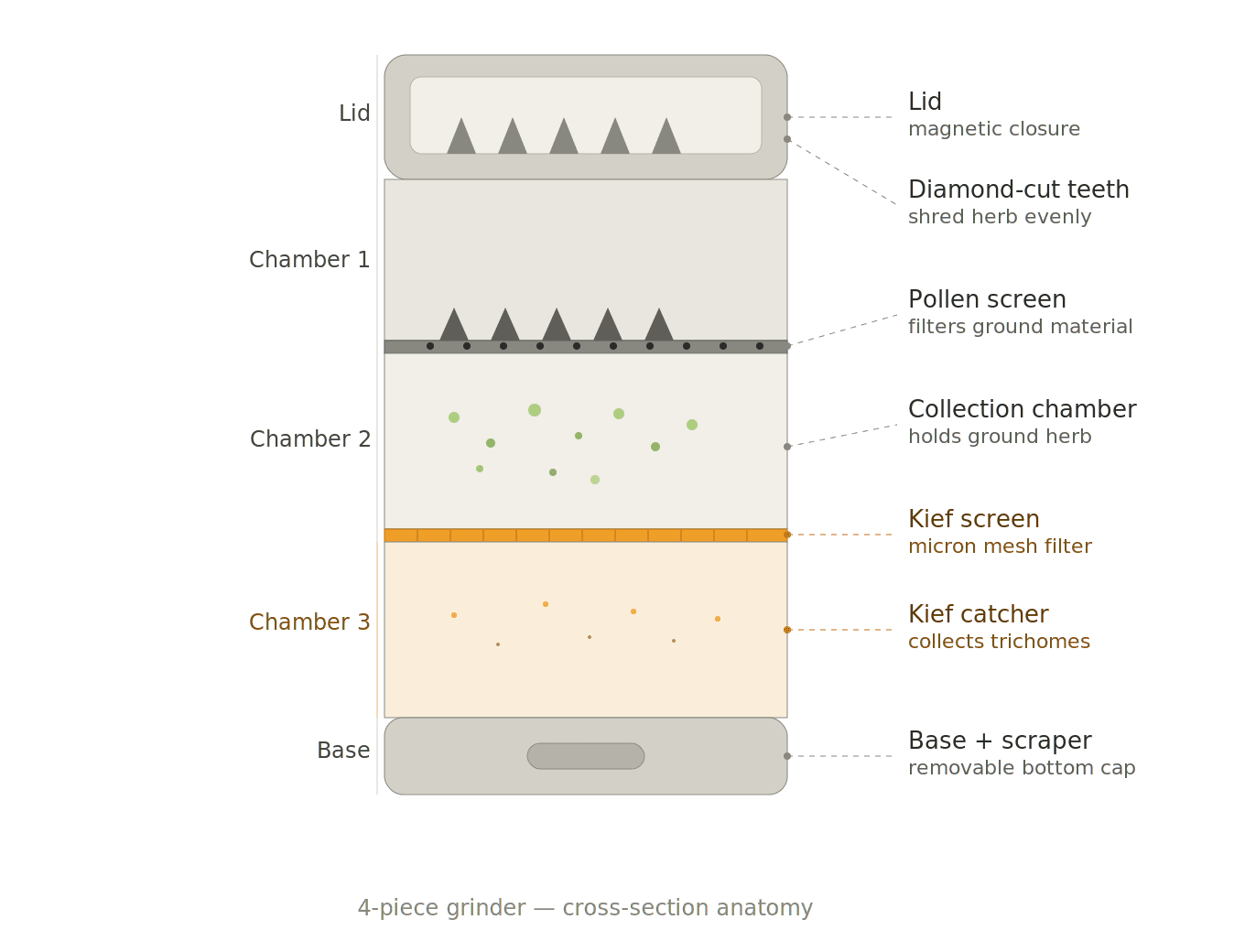
A grinder is the most purchased cannabis accessory and the most consistently under-researched purchase. Most buyers choose on price or look. A £12 grinder and a £45 grinder can produce meaningfully different results in daily use — but not always in the direction you expect.
This guide covers how grinders work, what actually separates good ones from bad ones, and how to use and maintain one correctly so it stays useful rather than becoming a drawer full of sticky problems.
CannabisDealsUS Price Index — Grinders
The CannabisDealsUS Price Index tracks 1,018 grinder SKUs across 200+ merchants. The Grinder sub-category index sits at 122.22 — the highest pricing power of any tracked hardware category — with discount penetration at just 0.6%.
What this means practically: grinders almost never go on sale. Fewer than 1 in 150 grinders is currently discounted. The £25–£45 range for quality aluminium models reflects real market pricing. Waiting for a discount is not a viable strategy in this category.
Source: CannabisDealsUS Price Index — updated weekly. Data as of week ending 16 Feb 2026.
WHAT YOU'LL LEARN
How Grinders Work
The mechanics of herb grinding — teeth design, chamber separation, and what a consistent grind actually does for your cannabis consumption.
2-Piece vs 3-Piece vs 4-Piece
What the chamber count means, what kief collection is and whether you need it, and which format matches your usage pattern.
Materials: What Matters
Aluminium vs zinc alloy vs acrylic vs wood. Which materials are worth paying for, which to avoid, and why it matters for your ground herb.
Size Guide
Small, medium, and large grinders serve different purposes. How to match size to your consumption volume and storage preferences.
How to Use a Grinder
Step by step correct use — loading, grinding technique, how much to load, and how to avoid the common errors that damage teeth and reduce consistency.
Cleaning and Maintenance
Grinders clog with resin faster than most buyers expect. What the cleaning routine looks like and how to keep kief screens open.
FAQs
Answers on kief, tooth design, sticking issues, and what to expect at different price points.
How Grinders Work
A grinder uses interlocking teeth to shred cannabis flower into consistently sized pieces. Consistent grind size matters because it determines how evenly your cannabis burns or vaporizes.
Unevenly ground cannabis — with large chunks alongside fine powder — burns inconsistently. The fine powder burns first, the chunks burn slower, and the result is wasted cannabis and an uneven experience. A good grinder produces a uniform medium-fine grind that packs evenly into a bowl or rolling paper with minimal waste.
The quality of the grind depends on three things: tooth shape (sharper teeth cut more cleanly), tooth density (more teeth create finer, more consistent output), and the fit between the two grinding halves (tight tolerances prevent loose pieces from bypassing the teeth entirely).
2-Piece vs 3-Piece vs 4-Piece
| Type | Chambers | What It Does | Best For |
|---|---|---|---|
| 2-piece | Grinding chamber only — herb falls directly into the bottom lid | Grinds herb and holds it in the same chamber | Simplicity, easy cleaning, portability. No kief collection. |
| 3-piece | Grinding chamber + separate collection chamber below with holes | Separates ground herb from grinding action; herb falls through holes into lower chamber | Cleaner separation, easier to access ground herb without opening grinding teeth |
| 4-piece (most common) | Grinding chamber + collection chamber + kief catcher below a mesh screen | Collects kief (trichomes that fall through the screen) separately from ground herb | Users who want kief collection. Best value for most regular users. |
Kief is the accumulated powdery trichome material that falls through the screen in a 4-piece grinder. It is significantly more potent than standard ground herb and can be added on top of bowls or used separately. Most regular users who try kief collection prefer 4-piece grinders once they understand what it does.
Materials: What Actually Matters
| Material | Quality | Price Range | Notes |
|---|---|---|---|
| Aircraft-grade aluminium (anodised) | Best — hard, lightweight, machine-cut teeth, stays sharp long-term | £20–£60+ | The standard for quality grinders. Anodised finish resists scratches and does not leave metal shavings in herb. |
| Zinc alloy | Adequate for occasional use — heavier than aluminium, softer metal, teeth wear faster | £10–£30 | Common in mid-range grinders. Acceptable quality; avoid very cheap zinc alloy which can leave metallic residue. |
| Acrylic / plastic | Low quality — teeth break, fit loosens quickly, cannot be properly cleaned | Under £10 | Avoid for regular use. The money saved is not worth the quality loss. |
| Wood | Aesthetic only — no real performance advantage, hard to clean properly | Variable | Novelty item. Not recommended for regular use. |
| Titanium | Premium — extremely hard, very lightweight, never corrodes | £40–£100+ | Marginal real-world performance improvement over quality aluminium. Worth it for users who want the best long-term. |
The most important material consideration is the vapour path, not the exterior. Good anodised aluminium at £25–£45 performs as well as most premium grinders for the vast majority of users.
Size Guide
| Size | Diameter | Grind Volume | Best For |
|---|---|---|---|
| Small | Under 50mm | 0.3g–0.5g per grind | Portability, travel, microdosing users |
| Medium | 50mm–63mm | 0.5g–1g per grind | Most everyday home and personal use. The most popular size. |
| Large | 63mm+ | 1g+ per grind | Heavy users, group sessions, users who want to grind in larger batches |
Most buyers choose medium (55mm–63mm). It is large enough to grind a full bowl in one go but compact enough to store easily and carry if needed. Very large grinders (75mm+) are primarily for heavy use or batch grinding.
How to Use a Grinder Correctly
- Break flower into smaller pieces before loading. Do not try to grind a whole bud. Remove the stem and break the flower into pieces roughly the size of a small grape. Stems damage teeth and large unbroken buds grind unevenly.
- Load the middle of the top chamber. Avoid placing herb directly in the centre where the magnet is — it will not get ground. Load around the teeth, not over the pivot point.
- Rotate 5–10 times. Forward and backward rotation helps the teeth grip more of the herb. 5–10 full rotations produces a medium-fine grind for most flower.
- Tap the grinder before opening. Tapping the closed grinder loosens any herb stuck in the teeth and ensures it falls through to the collection chamber.
- Open the collection chamber, not the grinding chamber first. Ground herb is in the lower chamber. Opening the top first risks spilling.
Cleaning and Maintenance
Grinders become sticky and inefficient faster than most buyers expect. Resin builds up on teeth and screens within 10–15 uses with regular flower. A sticky grinder is harder to turn, grinds less consistently, and can contaminate fresh herb with old residue.
Basic cleaning (every 15–20 uses):
- Place grinder in the freezer for 30 minutes. Cold temperatures make resin brittle and significantly easier to remove.
- Disassemble completely. Tap each piece over white paper to collect any remaining kief before cleaning.
- Use a stiff brush (a toothbrush works well) to scrub teeth and screen. Work residue out of the holes in the kief screen carefully — clogged screens stop kief collection entirely.
- For deep cleaning: soak metal pieces in isopropyl alcohol for 20–30 minutes, then scrub and rinse with warm water. Do not use alcohol on acrylic or painted surfaces.
- Dry completely before reassembling. Wet threads on the grinder body cause corrosion and sticking.
Grinder FAQs
Medium-fine for most uses — consistent pieces roughly the size of coarse sea salt. Too fine (powder) burns too quickly and can clog screens. Too coarse means uneven burning and poor extraction in vaporizers. For vaporizers specifically, a finer grind than for joints or bongs generally produces better results.
Resin buildup on the threads and inside the chambers. This is normal and expected with regular use. A 30-minute freezer session followed by brushing usually resolves it. If the threads themselves are damaged or stripped, the grinder needs replacing.
For regular users, yes. Accumulated kief is significantly more potent than standard ground herb and can be used to enhance individual sessions. A 4-piece grinder with a kief catcher pays for the slightly higher cost within a few weeks of regular use for most users.
Quality aluminium grinders in the £25–£50 range produce consistently better results than cheap zinc alloy or acrylic grinders in terms of grind consistency, durability, and long-term performance. Above £50, improvements are marginal. A £100 grinder does not produce meaningfully better ground herb than a good £35 aluminium model.
No. Dishwashers damage anodised surfaces, warp acrylic, and can introduce soap residue into threads. Isopropyl alcohol and a brush is the correct cleaning method for all grinder materials.
Browse Cannabis Grinders
Compare 1,000+ grinders from trusted headshop merchants.
Compare prices now: Best Grinder Deals — ranked by value, discount, and price across 200+ verified merchants.
Last updated: 02/24/2026 | Author: CannabisDeals Editorial Team | Educational content by CannabisDealsUS
Browse Products
Ready to Find the Best Deals?
The CannabisDealsUS Price Index tracks live discounts across 200+ verified merchants and brands. Compare prices before you buy.
Compare Prices →All Deals →