
Learning Center Guide
Table of Contents
ToggleUnderstanding how to choose a vaporizer starts with knowing that every device falls into one of three categories. Once you recognize these categories, it becomes much easier to avoid the most common and costly buying mistakes.
With over 1,600 vaporizers tracked across 200+ merchants, choosing the right device is the most important purchase decision a cannabis hardware buyer makes. The wrong choice costs £60–£170 and weeks of frustration. The right one lasts years.
This guide cuts through the noise. It explains the three device types, the specs that actually matter, and a clear decision framework based on how you actually use cannabis — not marketing language.
This page is part of the CannabisDealsUS Learning Center. For live device pricing and merchant comparisons, use the Vaporizer Insider hub below.
WHAT YOU'LL LEARN
The Three Device Types
Dry herb, concentrate, and dual-use vaporizers serve different purposes. Understanding which category fits your routine before looking at any specific product.
Conduction vs Convection
How your device heats cannabis is the single most important spec. Explains the difference, trade-offs, and which heating method suits which usage style.
Portable vs Desktop
Portability versus performance. What each format gives up and what it delivers, with a clear guide to which buyers each is actually built for.
The Specs That Matter
Battery life, chamber size, temperature range, and material quality. Which specs to check, which to ignore, and what the numbers actually mean.
How to buy a vaporizer - Decision Framework
A five-question framework to match device type to your usage pattern. Answers the question most buyers struggle with: dry herb or concentrate, portable or desktop.
Common Buying Mistakes
The five most expensive mistakes vaporizer buyers make, from choosing wrong heating type to overpaying for features they will never use.
What You Will Need
The accessories and tools required for each device type. What comes in the box, what to buy separately, and what to ignore.
FAQs
Direct answers to the most common vaporizer buying questions — budget, brand, maintenance, and compatibility.
The Three Device Types
Every vaporizer on the market falls into one of three categories. Choosing the wrong category is the most common and most expensive mistake buyers make.
| Type | What It Vaporizes | Best For | Avg Price Range |
|---|---|---|---|
| Dry herb vaporizer | Ground cannabis flower | Flower users who want the full spectrum of cannabinoids and terpenes with cleaner inhalation than smoking | £50–£350 |
| Concentrate vaporizer (dab pen) | Wax, shatter, live resin, oil | Concentrate users who want portability and precise dosing with high-potency extracts | £30–£200 |
| Dual-use vaporizer | Both flower and concentrates (with adapters) | Users who consume both formats and want one device, with trade-offs in performance for each | £80–£400 |
Dual-use devices do both jobs adequately but rarely either job as well as a dedicated device. If you exclusively use flower, a dry herb vaporizer will outperform a dual-use model at the same price point every time.
Conduction vs Convection Heating
Heating method determines vapor quality more than any other spec. Most buyers never check it.
| Method | How It Works | Vapor Quality | Efficiency | Best For |
|---|---|---|---|---|
| Conduction | Herb touches a heated surface directly | Can be uneven; some users get hot spots or combustion if herb is too dry | Lower — herb at edges heats less effectively | Budget devices, quick sessions, simplicity |
| Convection | Hot air passes through the herb chamber | Even, consistent, better flavour preservation | Higher — herb heats uniformly on demand | Quality-focused buyers, longer sessions, flavour priority |
| Hybrid (conduction + convection) | Combination of both methods | Balances fast heat-up with convection quality | Good all-round efficiency | Most versatile — best of both at mid-to-high price points |
Most devices under £80 use conduction. Most devices over £150 use convection or hybrid. If flavour and efficiency matter to you, budget at least £120–£150 and look for convection or hybrid heating explicitly stated in the specs.
Portable vs Desktop Vaporizers
| Format | Pros | Cons | Who It Is Built For |
|---|---|---|---|
| Portable | Discreet, battery-powered, use anywhere, most models under £200 | Smaller chambers, battery life limits session length, less vapour volume | Solo users, commuters, anyone who values flexibility over maximum performance |
| Desktop | Consistent power, large chambers, best vapor quality available, long sessions | Mains-powered only, not portable, higher cost (£150–£700+) | Home users who prioritise performance, group sessions, medical users with high volume needs |
The CannabisDealsUS Price Index tracks 1,656 vaporizer SKUs with an average effective price of £66.87. The vast majority are portable devices. Desktop units command significant price premiums and represent a small share of the tracked market but a disproportionate share of premium buyer searches.
The Specs That Actually Matter
Vaporizer listings contain dozens of spec claims. Most are irrelevant. These are the four that affect daily use.
| Spec | What to Look For | What to Ignore |
|---|---|---|
| Temperature range | 180°C–230°C minimum range with adjustable control. Lower temps for flavour, higher for effect intensity. | Pre-set modes with no manual control limit flexibility significantly |
| Chamber size | 0.2g–0.5g for portable solo use. 0.5g+ for sharing or longer sessions. | Very large chambers on portable devices often indicate inefficient heating design |
| Battery life | 30–90 minutes of continuous use. Replaceable batteries are a significant longevity advantage. | mAh ratings alone — session count at typical temperature is a better measure |
| Build materials | Medical-grade stainless steel, ceramic, or borosilicate glass in the vapour path. Check what the vapour actually touches. | Plastic in the vapour path degrades and affects taste. Check specs, not just external housing material. |
How to Buy a Vaporizer: Five Questions
Answer these in order. The answers narrow your choices faster than reading 20 reviews.
- Do you use flower, concentrates, or both? If flower only → dry herb. If concentrates only → dab pen. If both → dual-use or two devices.
- Where will you primarily use it? At home only → consider desktop. On the move → portable only.
- How important is flavour vs convenience? Flavour priority → convection heating, budget £120+. Convenience priority → conduction, budget £50–£100.
- Solo use or group sessions? Solo → smaller chamber, portable. Group → larger chamber, consider desktop.
- What is your realistic budget? Under £80 → entry conduction portable. £80–£150 → mid-range convection portable. £150–£300 → premium portable or entry desktop. £300+ → premium portable or mid desktop.
Most buyers who are frustrated with their device skipped question 1 or question 3. The heating method question eliminates more wrong purchases than price alone.
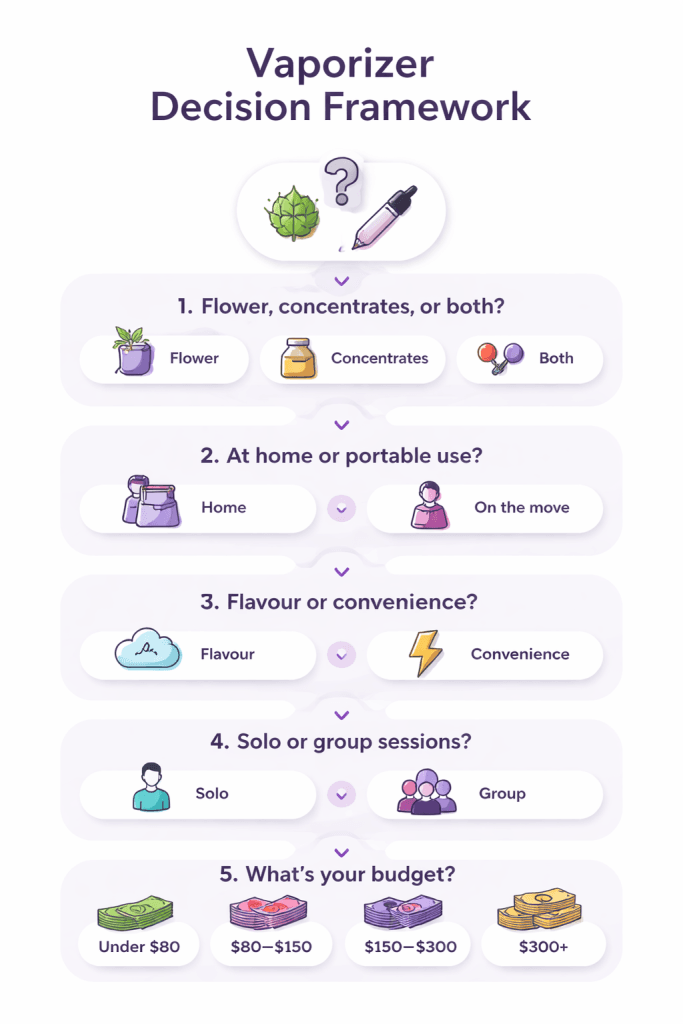
How to Buy a Vaporizer - Decision Framework
Answer these in order. Your answers narrow options faster than reading reviews.
Note: Most wrong purchases come from skipping Question 1 or Question 3. Heating method eliminates more bad fits than price alone.
Common Vaporizer Buying Mistakes
- Buying a dual-use device when you only use one format. Dual-use devices make both jobs slightly worse. If you only use flower, a dedicated dry herb vaporizer at the same price will perform better.
- Choosing conduction when flavour is a priority. If you care about taste, spend £120+ and get convection or hybrid heating. Conduction devices at any price cannot match convection for flavour.
- Ignoring the vapour path material. Plastic in the vapour path is a genuine quality problem that no amount of positive reviews overcomes. Check what the vapour actually contacts before buying.
- Underestimating maintenance. All vaporizers require regular cleaning to perform. If you will not clean a device every 5–10 sessions, buy something simple and robust rather than technically impressive.
- Buying based on brand name alone. Several well-marketed brands sell overpriced conduction devices. Use heating method, material quality, and the decision framework above rather than brand recognition.
What You Will Need
| Item | Purpose | Essential? |
|---|---|---|
| Grinder | Consistent grind improves airflow and heat distribution in dry herb devices significantly | Yes — for dry herb vaporizers |
| Isopropyl alcohol (91%+) | Primary cleaning agent for chambers, mouthpieces, and vapour paths | Yes — for all devices |
| Cotton swabs | Precision cleaning for coils, screens, and connection points | Yes |
| Carrying case | Protects portable devices during transport and keeps accessories together | Recommended |
| Replacement screens | Screens clog over time; spares avoid downtime | Recommended — buy at same time as device |
| Concentrate inserts | Required for using concentrates in a dry herb or dual-use device | Only if using concentrates in a dry herb device |
Vaporizer Buying FAQs
For flower: a mid-range convection portable in the £100–£150 range gives the best combination of quality and ease of use. For concentrates: a reliable 510-thread battery with a quality cartridge is the simplest entry point. Avoid very cheap devices — heating element quality matters and cannot be seen in photos.
Entry-level conduction portables start at £40–£80 and work adequately. Convection portables that perform well start at around £120. Premium portables and entry desktop devices range from £150–£300. Anything over £300 is for users with specific high-performance requirements.
Dual-use devices exist and work, but dedicated devices outperform them at the same price. If you use both regularly, a separate dry herb vaporizer and a dab pen often gives better results than a single dual-use device at twice the price.
Every 5–10 sessions for light cleaning, every 20–30 sessions for a deep clean. Devices that are not cleaned regularly produce worse vapour quality, clog, and eventually fail. Cleaning time is around 10–15 minutes with isopropyl alcohol and cotton swabs.
For flavour quality and efficiency, convection and hybrid devices in the £150–£300 range do deliver meaningfully better results than entry conduction devices. Above £300, improvements are incremental and most buyers will not notice the difference in daily use.
For flavour: 170°C–185°C. For balanced effect and flavour: 185°C–200°C. For maximum vapour production: 200°C–215°C. Above 220°C you risk combustion in conduction devices. Most users settle in the 185°C–200°C range for everyday use.
Vaporizing avoids combustion and reduces exposure to the byproducts of burning plant material. NORML-cited research shows significantly lower levels of combustion toxins in vapour compared to smoke. It does not eliminate all respiratory risk, particularly at high doses or temperatures.
For evidence‑based information on cannabis and public health, the CDC provides research‑driven educational resources that help readers understand effects, risks, and responsible use.
Compare Vaporizer Prices
Browse 1,600+ vaporizers from 200+ merchants. Filter by type, price, and brand.
Last updated: 02/24/2026 | Author: CannabisDeals Editorial Team | Educational content by CannabisDealsUS
Ready to Find the Best Deals?
The CannabisDealsUS Price Index tracks live discounts across 200+ verified merchants and brands. Compare prices before you buy.
Compare Prices →All Deals →