
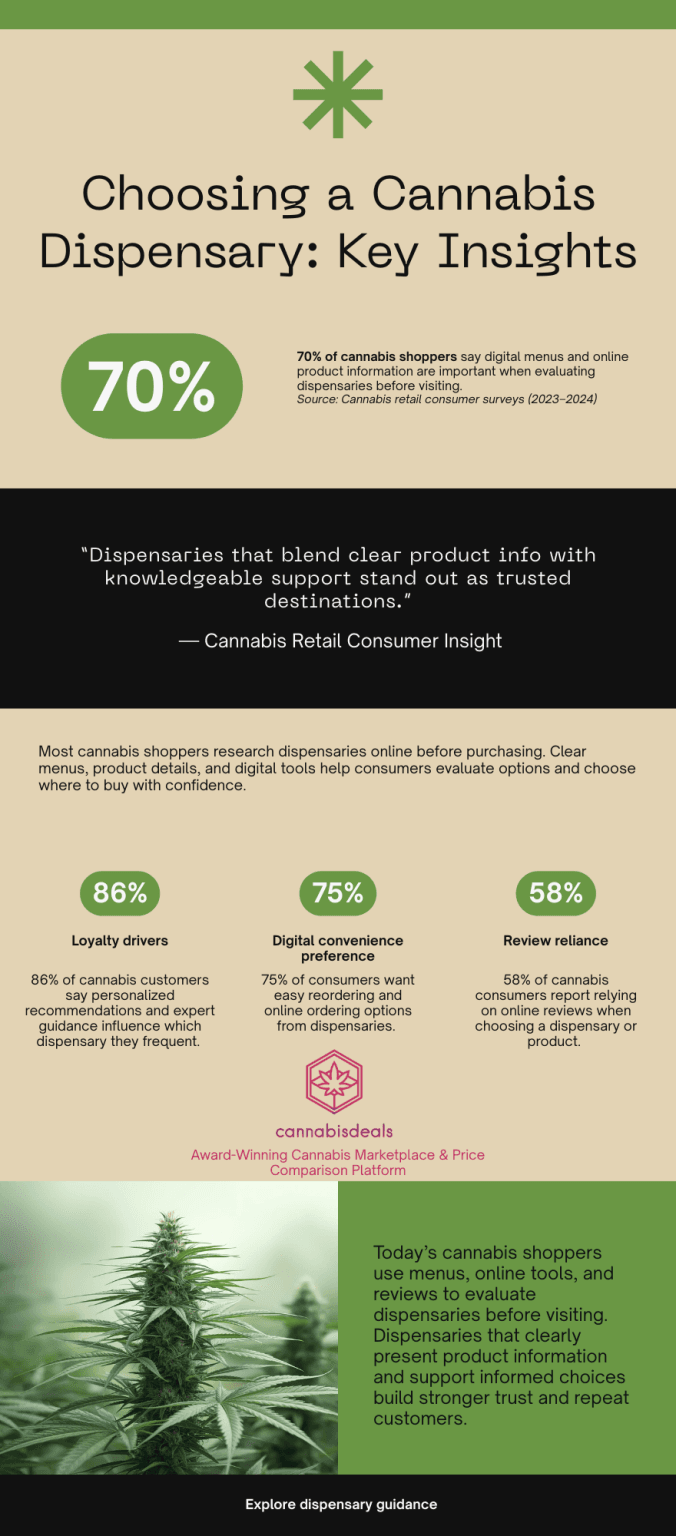
WHAT YOU’LL LEARN
This guide shows you how to evaluate a cannabis dispensary using practical checks you can do in minutes.
You will learn what licensing and lab testing should look like, how to compare menus and pricing, and how to spot red flags that beginners often miss.
Table of Contents
ToggleWhat Is a Cannabis Dispensary?
Explains what a licensed cannabis dispensary is, how dispensaries operate, and the differences between medical and adult use retailers before you start comparing options.
Step by Step Guide
A practical walkthrough for choosing the right dispensary, covering licensing checks, menu transparency, lab testing, pricing comparisons, staff quality, and convenience factors.
Common Mistakes
Highlights frequent shopper mistakes such as choosing based only on price, ignoring lab results, trusting unclear menus, or assuming all dispensaries follow the same standards.
TOOLS AND resources
Outlines simple tools and reference points that help you compare dispensaries more effectively, from price checks and menu reviews to license verification and testing access.
FAQs
Answers common questions about dispensary legitimacy, online ordering safety, medical versus adult use options, pricing differences, and what beginners should prioritize.
What Is a Cannabis Dispensary?
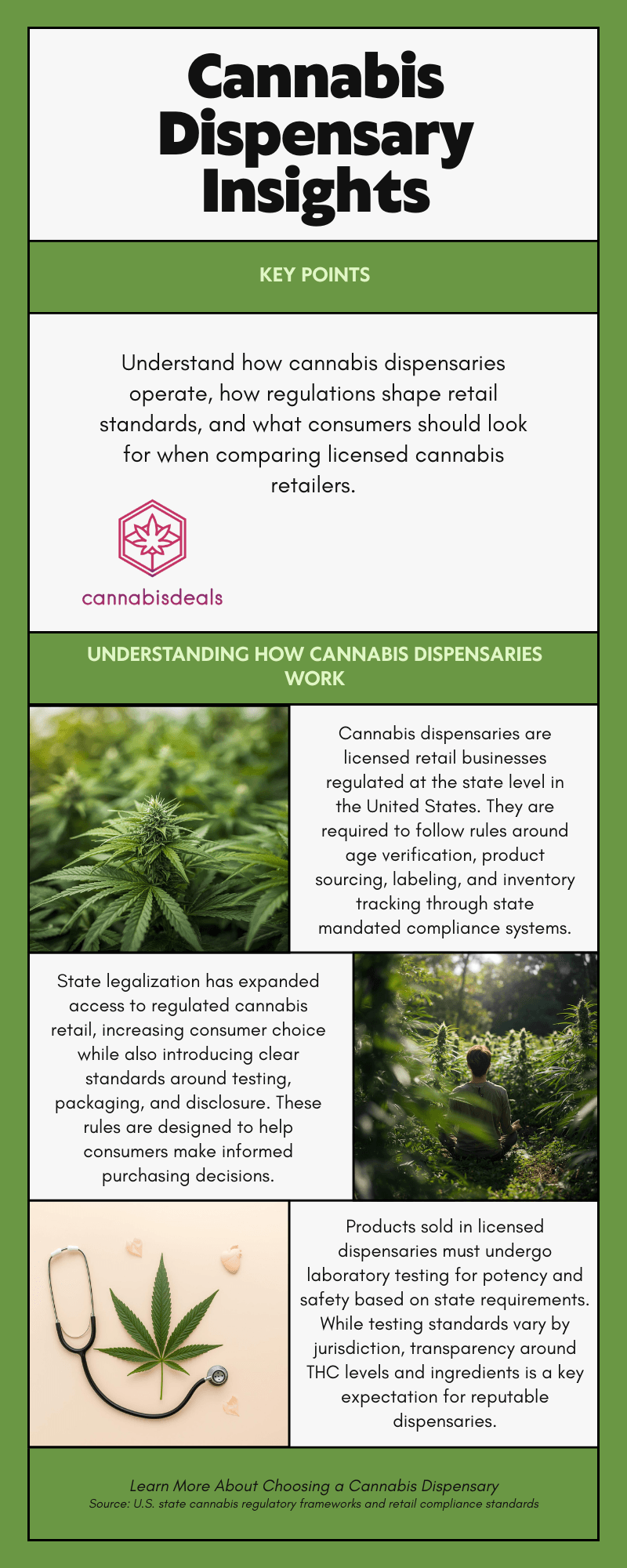
An overview of how licensed cannabis dispensaries operate, including regulation, testing requirements, and consumer considerations.
A cannabis dispensary is a licensed retailer that sells regulated cannabis products such as flower, vapes, edibles, oils, capsules, and accessories.
Dispensaries operate under state rules that typically require age verification, track and trace compliance, and standardized product labeling.
Some dispensaries focus on medical cannabis patients and may carry higher potency or condition specific products.
Others serve adult use customers and emphasize convenience, selection, and value.
In both cases, reputable dispensaries are consistent about sourcing, testing transparency, and clear menu information.
Quick Verification Checklist
Print or save this checklist before your first purchase from any dispensary:
- ☐ License verified (checked state database, shows active status)
- ☐ Lab results accessible (can view certificates for products you’re considering)
- ☐ Menu shows potency (THC/CBD percentages clearly listed)
- ☐ Recent reviews checked (read 10+ reviews from past 3 months)
- ☐ Pricing compared (checked 2-3 other dispensaries for same products)
- ☐ Return policy understood (know what happens if product is defective)
- ☐ Staff answers questions (willing to explain without pressure)
- ☐ Product dates visible (can see harvest/packaging dates before buying)
✓ If you can check 7/8 of these, you’ve found a solid dispensary.
⚠ If you can only check 4 or fewer, consider looking elsewhere.
Step by Step Guide to Choosing a Cannabis Dispensary
- Verify licensing and compliance Look for a state license number displayed in store or on the dispensary website. Licensed operations are more likely to carry tested and correctly labeled products.
- Check the menu for clarity A strong menu lists THC and CBD potency, strain type, format size, and basic effects guidance. Vague menus often signal weak product information practices.
- Confirm lab testing access Look for third party lab certificates that cover potency and common safety tests. If lab results are unavailable or hard to find, treat it as a red flag.
- Compare prices and value Compare typical prices for items you actually buy, like a standard edible pack or a vape cartridge. Extremely low prices can indicate older inventory or lower quality.
- Evaluate staff support Good staff explain formats, dosing, and effect differences without pushing the highest priced option. Beginner friendly guidance matters.
- Read independent reviews Look for patterns around freshness, labeling accuracy, wait times, delivery reliability, and customer service. Patterns matter more than one off complaints.
- Match the dispensary to your lifestyle Choose based on what you value most: in store help, fast pickup, reliable delivery, or consistent pricing. Convenience should never replace compliance and transparency.
Verify licensing and compliance
Every legitimate dispensary must display a valid state license number. Here’s how to verify it in under 2 minutes:
Where to find the license number:
- In-store: Posted near the entrance or checkout counter, usually on an official certificate
- Online: Typically in the footer, “About Us” page, or a dedicated compliance section
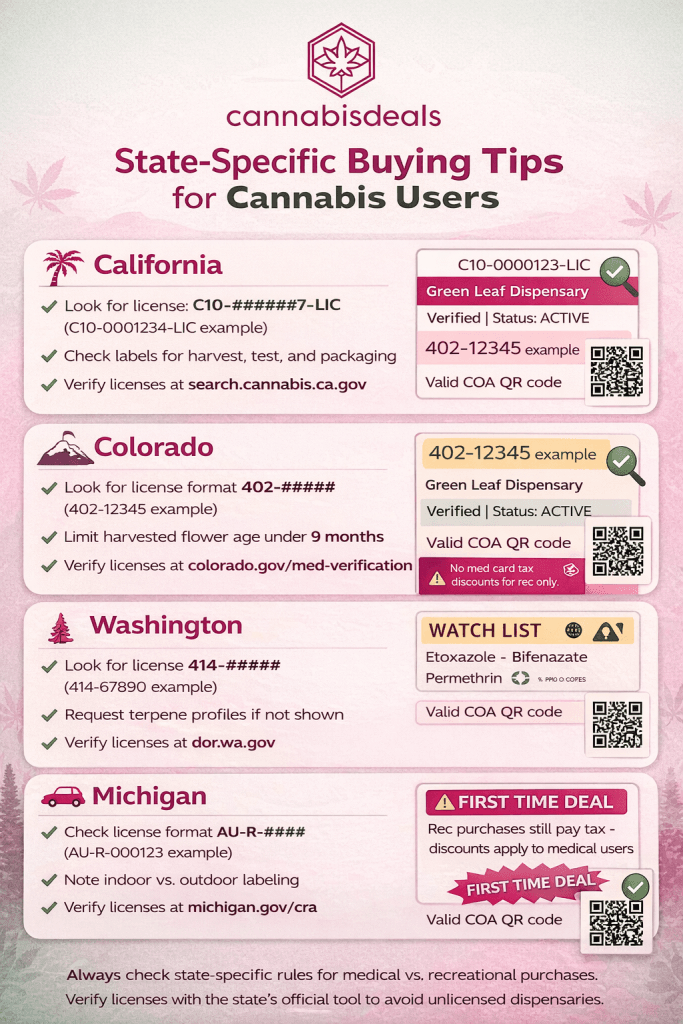
- Look for format patterns: California uses “C10-” followed by numbers (e.g., C10-0000123-LIC), Colorado uses “402-” format, Washington uses “414-” format
How to verify it’s legitimate:
- Copy the exact license number from the dispensary
- Visit your state’s cannabis regulatory website:
- California: Bureau of Cannabis Control license search
- Colorado: Colorado Department of Revenue MED search
- Washington: LCB license lookup tool
- [Check your state’s regulatory body]
- Enter the license number and confirm the business name matches
- Check the status shows “Active” or “Current” (not “Suspended” or “Expired”)
Red flags that indicate unlicensed operations:
- “Pending license” displayed for more than 90 days
- No license number visible anywhere on website or premises
- License number doesn’t appear in state database
- Business name on license doesn’t match the dispensary name
- Website uses phrases like “gray market” or “delivery only – no storefront”
Common Mistakes (And How to Avoid Them)
Mistake 1: Choosing only by lowest price
- Why it’s a problem: $15 for a 1/8 oz might mean 6-month-old product with degraded cannabinoids
- Better approach: Compare price per mg of THC/CBD, check harvest dates, read freshness reviews
- Real example: Customer bought $10 pre-rolls that were harsh and barely effective vs. $15 fresh pre-rolls that delivered expected effects
Mistake 2: Trusting strain names alone
- Why it’s a problem: “Blue Dream” at one dispensary might be 15% THC while another’s is 24% THC
- Better approach: Always check the actual lab-tested potency and terpene profile, not just the strain label
- What to do: Ask “What’s the THC percentage on this specific batch?” before assuming effects
Mistake 3: Ignoring the harvest or packaging date
- Why it’s a problem: Cannabis degrades over time—THC converts to CBN, terpenes evaporate, flavor diminishes
- Better approach: Look for products packaged within 3-6 months; avoid anything over 1 year old
- Red flag: Dispensary won’t show you dates or says “it doesn’t matter”
Mistake 4: Assuming all edibles hit the same
- Why it’s a problem: 10mg from a professionally-made gummy ≠ 10mg from a homemade cookie; absorption varies wildly
- Better approach: Start with reputable brands, consistent formats, and give edibles 90-120 minutes before re-dosing
- Beginner rule: Start with 2.5-5mg, wait 2 hours, never double-dose impatiently
Mistake 5: Buying based on budtender recommendation alone
- Why it’s a problem: Some staff are trained to upsell expensive products or push slow-moving inventory
- Better approach: Research beforehand, ask specific questions, cross-reference their suggestions with reviews
- Good question to ask: “What do customers who are new to this usually buy?” instead of “What’s your best?”
Mistake 6: Not reading the return policy
- Why it’s a problem: Many dispensaries have strict no-return policies on opened products, even defective ones
- Better approach: Ask before purchasing: “What if this product is defective or not what I expected?”
- What fair policies look like: Exchanges for unopened products, returns for clearly defective items (broken vapes, moldy flower)
Mistake 7: Ordering online without checking reviews first
- Why it’s a problem: Delivery delays, wrong products, poor packaging happen frequently with some services
- Better approach: Check Google reviews, Reddit discussions, and delivery-specific feedback before first order
- Warning signs: Complaints about late delivery (2+ hours), wrong orders, poor customer service response
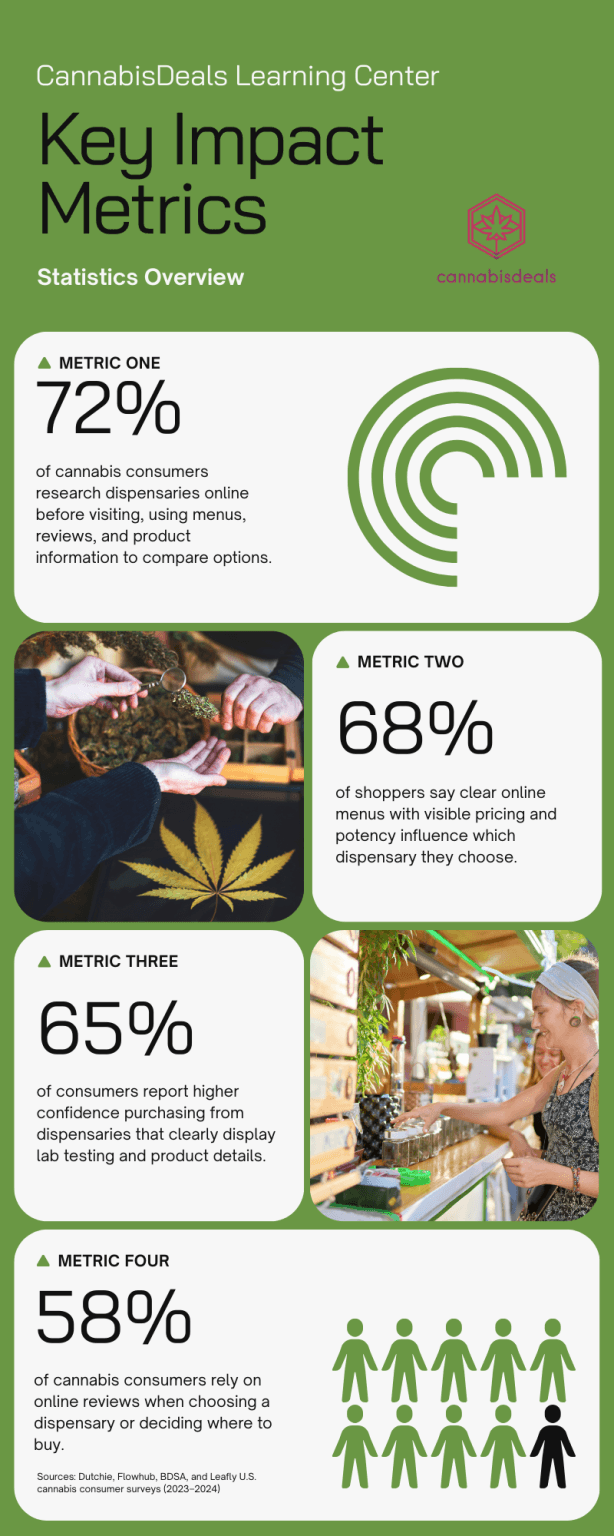
Reading Lab Results Like a Pro
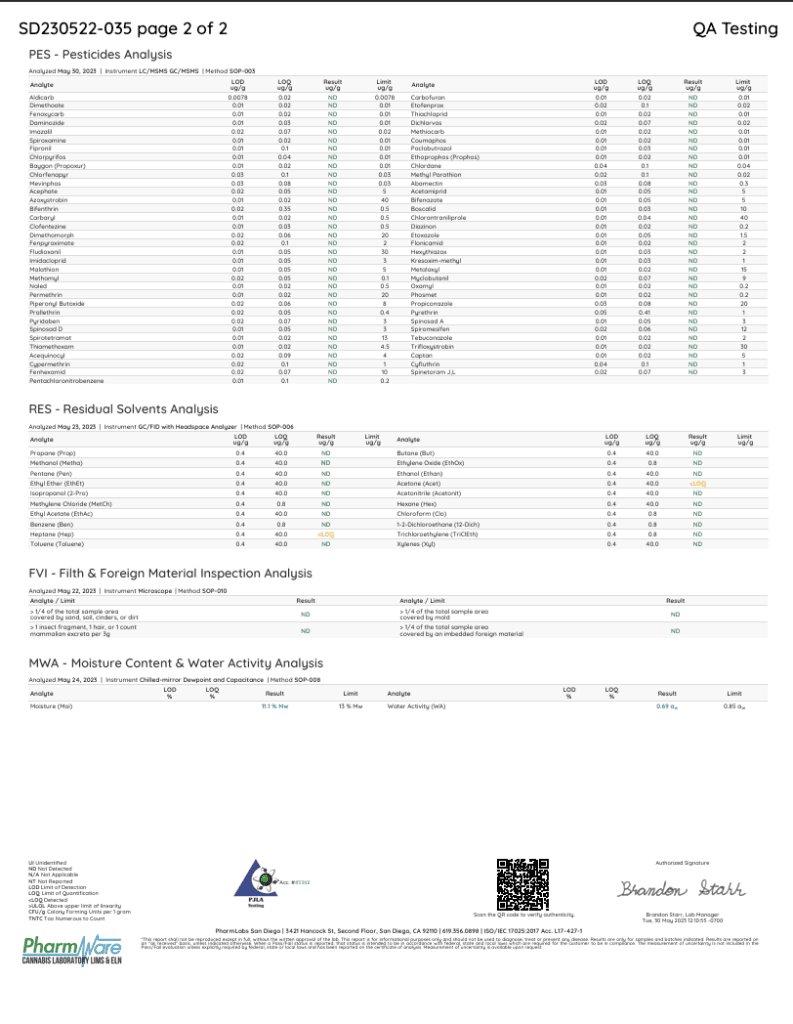
Confirm third-party lab testing (What to actually look for)
Lab certificates tell you if a product is safe and accurately labeled. Here’s what matters most:
Essential tests every product should have:
1. Cannabinoid profile (The basics)
- Shows THC and CBD percentages
- Should match the label within 10% margin
- Example: Label says 20% THC → Lab result should show 18-22% THC
- If numbers are wildly different, the product may be mislabeled or the batch is old
2. Contaminant screening (The safety tests)
Look for “PASS” results on these five critical tests:
- Pesticides: Should show “None Detected” or levels below state limits
- Heavy metals: Lead, arsenic, cadmium, mercury – all should be below action levels
- Microbials: Bacteria, mold, yeast – should pass or show “Absent”
- Residual solvents: For vapes and concentrates – should be below safety thresholds
- Mycotoxins: Toxic mold byproducts – should be “Not Detected”
3. Batch information
- Harvest date or manufacturing date (fresher is better – ideally within 6 months)
- Batch or lot number (should match what’s on your product package)
- Test date (should be recent, not years old)
How to access lab results:
- Best practice: QR code on package that links directly to certificate
- Good: Lab results posted on dispensary website by product
- Acceptable: Results available upon request from staff
- Red flag: Staff says “we don’t have those” or “the grower handles that”
Example of what to look for:
✓ Good lab certificate shows:
- Laboratory name and license number
- All tests performed with clear pass/fail status
- Specific numerical results (not just “pass”)
- Test date within 3-6 months
- Batch number matching your product
⚠ Questionable certificate:
- Missing contaminant tests (only shows potency)
- Test date is over 1 year old
- No laboratory license number listed
- Results seem too perfect (exactly 20.0% THC with no variation)
- Missing signature or accreditation information
💡 Pro tip: Take a photo of the lab certificate for products you like. This helps you compare batches and quality over time.
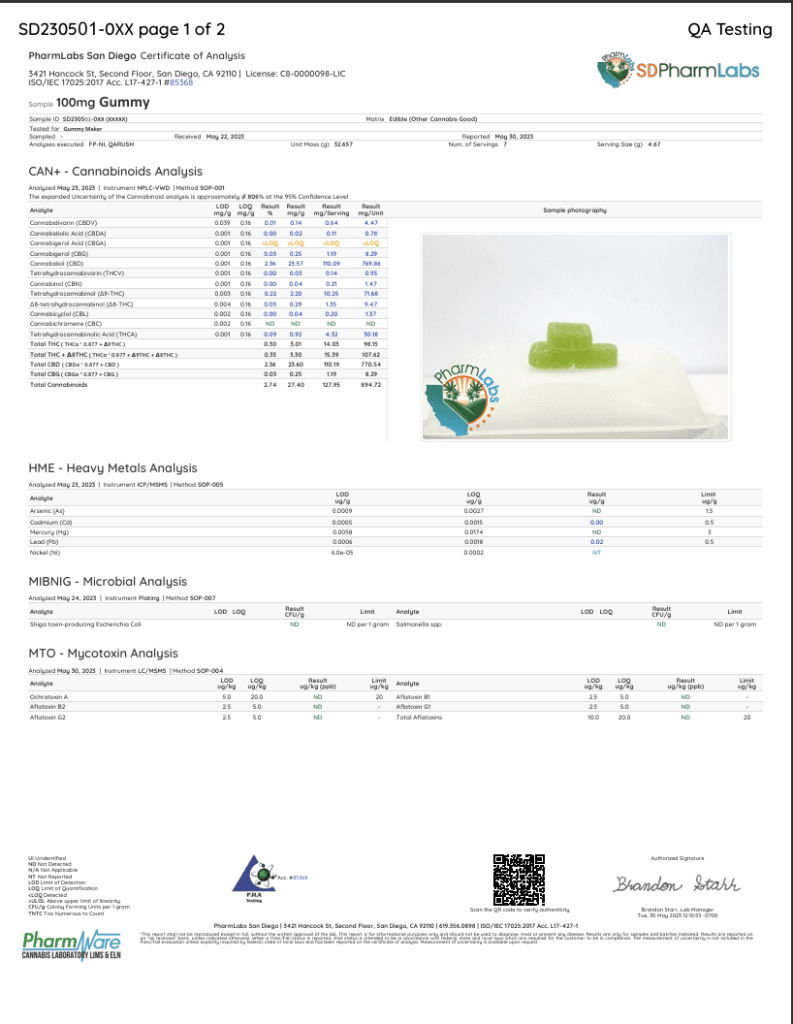
Step by Step Guide to Choosing a Cannabis Dispensary
- Verify licensing and compliance
Look for a state license number displayed in store or on the dispensary website. Licensed operations are more likely to carry tested and correctly labeled products. - Check the menu for clarity
A strong menu lists THC and CBD potency, strain type, format size, and basic effects guidance. Vague menus often signal weak product information practices. - Confirm lab testing access
Look for third party lab certificates that cover potency and common safety tests. If lab results are unavailable or hard to find, treat it as a red flag. - Compare prices and value
Compare typical prices for items you actually buy, like a standard edible pack or a vape cartridge. Extremely low prices can indicate older inventory or lower quality. - Evaluate staff support
Good staff explain formats, dosing, and effect differences without pushing the highest priced option. Beginner friendly guidance matters. - Read independent reviews
Look for patterns around freshness, labeling accuracy, wait times, delivery reliability, and customer service. Patterns matter more than one off complaints. - Match the dispensary to your lifestyle
Choose based on what you value most: in store help, fast pickup, reliable delivery, or consistent pricing. Convenience should never replace compliance and transparency.
Tools and Resources
| Purpose | What to Look For |
|---|---|
| License verification | A state license number shown clearly on the website or in store, plus consistent age verification. |
| Menu comparison | Clear THC and CBD potency, format size, strain type, price per unit, and consistent product naming. |
| Lab results access | Third party test certificates you can view, including potency and standard safety screening. |
| Review checks | Recent feedback that mentions freshness, labeling accuracy, wait times, delivery reliability, and service quality. |
| Beginner guidance | Staff that explain dosing and effects clearly, with zero pressure and sensible beginner recommendations. |
| Convenience fit | Pickup and delivery options, predictable hours, clear policies, and consistent inventory updates. |
Compare prices and value (Real-world benchmarks)
Price varies significantly by state, but you can spot outliers and ensure you’re getting fair value.
Standard price ranges by product type (2025 averages):
| Product Type | Typical Range | Price per Use | What Affects Cost |
|---|---|---|---|
| Flower (1/8 oz) | $25-$60 | $3-7 per session | THC %, indoor vs outdoor, brand |
| Pre-rolls (1g) | $8-$18 | $8-18 per use | Strain, infused vs regular, packaging |
| Vape cart (0.5g) | $25-$50 | $0.50-1 per session | Live resin vs distillate, brand |
| Edibles (100mg) | $15-$30 | $1.50-3 per 10mg dose | Ingredients, brand, format |
| Tincture (30ml) | $30-$70 | $1-2 per dose | CBD:THC ratio, carrier oil, potency |
Red flags in pricing:
- Too cheap: $10 for a 1/8 oz might mean old product, low potency, or poor growing conditions
- Too expensive: $80 for standard flower without exceptional testing or genetics is markup for marketing
- Inconsistent: Same product fluctuates $15+ week to week (poor inventory management)
- Hidden costs: “Plus tax” adds 20-37% depending on your state—always ask for out-the-door pricing
Smart comparison strategy:
- Pick 3 products you’d actually buy (e.g., a 10mg edible, popular strain, basic vape)
- Compare those exact items at 3-5 dispensaries
- Calculate price per milligram of THC: Total price ÷ total mg THC
- Factor in deals: Some dispensaries offer first-time discounts (15-30% off) or loyalty programs
- Check for bundling: “Mix and match” deals can reduce per-unit cost by 20%
Value indicators beyond price:
- Consistent freshness (check packaging dates)
- Accurate dosing across multiple purchases
- Easy returns or exchanges for defective products
- Transparent about sales tax in listed prices
- Rewards program that actually provides value (not $1 per $100 spent)
Example calculation:
- Dispensary A: 100mg edible for $25 = $0.25/mg THC
- Dispensary B: 100mg edible for $18 = $0.18/mg THC + 20% first-time discount = $0.144/mg THC
- Dispensary C: 100mg edible for $30 but buy-2-get-1 deal = $0.20/mg THC
Dispensary B offers the best first-time value, but compare product quality and reviews before deciding.
 Quick Price Comparison Calculator
 Quick Price Comparison Calculator
Calculate the real cost per dose across dispensaries:
Price per mg THC:
$8.000
Total with tax:
$8000.00
Cost per 10mg dose:
$80.00
FAQs ABOUT CHOOSING THE RIGHT CANNABIS DISPENSARY
Clear answers to the most common questions about choosing a cannabis dispensary, including licensing, product safety, pricing differences, online ordering, and what first time shoppers should look for.
A legitimate dispensary displays a valid license and sells products with required labeling and testing transparency.
They can be safe if they are licensed and provide clear product information, testing access, and verified delivery or pickup processes.
No. Higher prices do not guarantee quality. Consistent labeling, testing access, and reliable inventory matter more.
Clear menus, beginner friendly staff, simple product options, and transparent testing are usually the best starting points.
Missing license info, unclear labels, no lab testing access, inconsistent pricing, and heavy upselling without guidance.
If you qualify for medical cannabis, medical dispensaries can offer different options and pricing structures. Otherwise, adult use dispensaries are designed for general access.
State-Specific Considerations
Know your state’s rules (Quick reference)
Cannabis regulations differ dramatically by location. Here’s what changes:
License format and verification:
- California: C10-license numbers, verify at bcc.ca.gov
- Colorado: 402-licenses, check at colorado.gov/pacific/enforcement
- Michigan: Adult-use and medical have different license types
- Massachusetts: Three license classes (cultivator, manufacturer, retailer)
Purchase limits (adult-use typical examples):
- 1 ounce flower: CA, CO, MA, NV
- 2.5 ounces flower: OR
- 2 ounces flower: AK
- Edibles: Usually 800-1,000mg THC total per transaction
- Concentrates: 5-8 grams depending on state
Testing requirements vary:
- Strictest: California (pesticides, microbials, heavy metals, mycotoxins, solvents mandatory)
- Moderate: Colorado, Washington (potency + contaminant screening)
- Developing: Some states only require potency testing
Medical vs. adult-use differences:
- Medical benefits: Higher purchase limits, lower taxes (0-7% vs 15-37%), access to higher potency products
- Medical requirements: Valid state medical card, qualifying condition, sometimes doctor consultation fees ($50-200)
- Adult-use: 21+, no card needed, higher taxes, lower purchase limits
Where to find your state’s specific rules: Search “[Your state] cannabis control board” or “[Your state] marijuana regulatory agency” to find official limits, testing requirements, and dispensary license verification tools.
🔍 Find Your State’s License Verification Tool
🗺️ Find Licensed Dispensaries Near You
Finding dispensaries near you…
We don’t store your location data. This feature only helps you find nearby licensed dispensaries.
Explore More Dispensary Guidance
The best cannabis dispensary is the one that is consistent about compliance, clear information, and fair pricing. Discover more insights in our dedicated Guide.
Last updated: 12/26/2025 |
| Educational content by CannabisDealsUS
Ready to Find the Best Deals?
The CannabisDealsUS Price Index tracks live discounts across 200+ verified merchants and brands. Compare prices before you buy.
Compare Prices →All Deals →